Feeld is a dating app for the curious, with curiosity embedded into how the company operates. As the business grew, teams across Feeld wanted to ask more sophisticated questions of their data. A company-wide survey made it clear that while the analytics foundations were already strong, the experience needed to scale to expand access, depth, and consistency across the organisation.
Bobby den Bezemer joined Feeld as Director of Analytics with the mandate to expand data enablement across the business and to upgrade the data consumption experience. Feeld moved to Omni to build a trusted foundation for AI-driven analysis on a governed semantic layer. As a result, more colleagues across more teams can confidently explore data and ask better questions, using their curiosity to drive how the company operates.
Results #
2x data adoption: Weekly active users doubled within months of rolling out Omni, compared to years on their previous BI tool.
60% AI adoption: Over half of all users interacted with AI to explore data within the first months of rollout.
80% faster diagnosis: A combination of AI-guided insights and enhanced point-and-click workflows enables teams to answer questions instantly, compressing time-to-insight and elevating analysts into true business partners.
100% finance engagement: Automated several manual spreadsheet workflows with governed reporting and AI-assisted analysis, eliminating duplicate pipelines and operational risk.
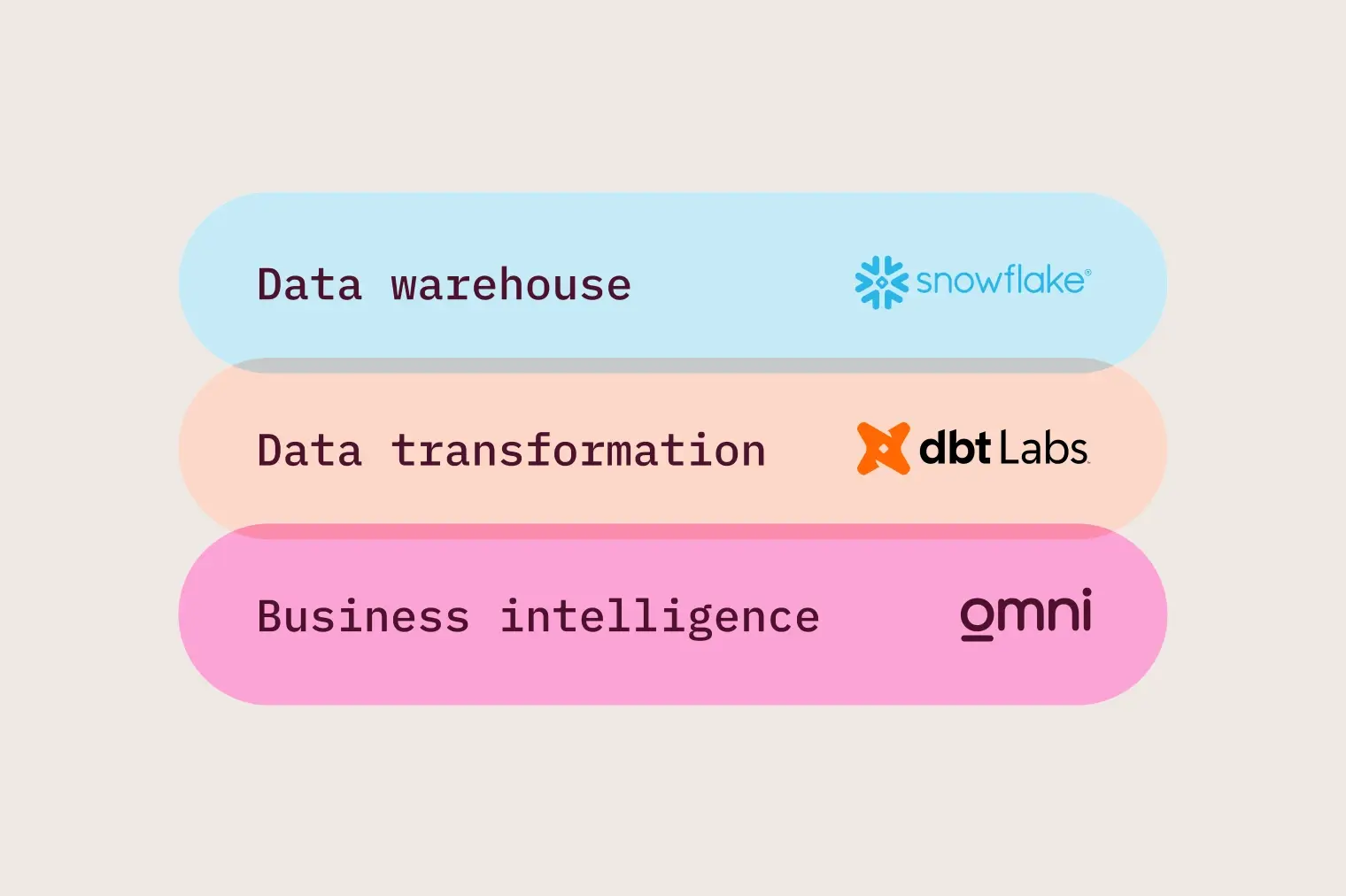
Feeld's Data Stack #
The challenge #
When Bobby joined Feeld as Director of Analytics, he explored the existing data-rich environment by taking a closer look at how teams experienced and engaged with analytics day to day. A company-wide survey highlighted a familiar challenge in scaling organisations: while data was abundant, levels of adoption, confidence, and fluency varied across teams. Product teams made strong use of Amplitude for user insights, but business reporting told a different story. The rigid interface of Feeld’s legacy BI tool discouraged non-technical users from exploring data. This pushed many users towards isolated spreadsheets for their flexibility and contributed to sprawl in analytics notebooks, or worse, led them to avoid data altogether.
Over time, this approach became difficult to scale. The company’s primary “source of truth” for performance was a manually maintained Google Sheet, the company's KPI tracker, containing 70 critical metrics. While effective as a shared reference point, every update introduced potential points of failure and placed an increasing maintenance burden on the data team, which limited their ability to focus on more strategic initiatives.
This wasn’t just a tooling issue; it was an experience challenge. Feeld is a company built on curiosity and design, but its analytics tools made exploration feel rigid and high-effort. As Feeld evolved, so did its expectations of analytics. The goal wasn’t to replace what worked, but to expand what was possible — to create an environment that lowered the risk of exploration, broadened access responsibly, and aligned more closely with how teams at Feeld think and work.
The evaluation #
Bobby approached the search intentionally — designing a rigorous, structured evaluation matrix and working with the team to assess modern BI solutions across dozens of criteria. The proof of concept (POC) examined areas including semantic modelling and governance, AI maturity, visualisation flexibility, commercial considerations, and overall suitability for Feeld’s users. While some options were already familiar to the data team, the evaluation showed that approaches optimised primarily for more technical workflows would not meet the needs of the wider organisation. This evaluation and proof of concept were delivered by a cross-functional project team, which brought together data platform, analytics, and business stakeholders to test real workflows and requirements in practice.
Through the evaluation, Omni emerged as the strongest fit based on:
Built-in semantic model, which enables dynamic aggregations & governed exploration without sacrificing flexibility
Excel-native interface addresses a long-standing pain point by giving teams the flexibility to work with a familiar interface & syntax
Conversational AI experience felt uniquely aligned with Feeld’s design-driven culture, giving the team a more human interface for interacting with data
During the POC, the partnership itself became a differentiator. The Omni team didn’t just demonstrate features. They helped Feeld set up a foundation for success by diving into how to structure Topics (curated datasets), modeling decisions, and best practices for dashboard architecture. Feeld saw a tool and a team that understood how to support a company built around creativity and curiosity.
The impact #
Finance: Automating company reporting while preserving flexibility #
A key test for any BI tool was whether it could support finance with scalable, automated reporting without taking away the flexibility spreadsheets provide. At Feeld, Omni became the primary analytics workspace for company-level reporting and KPI analysis, with full adoption across the finance team. This enabled consistent, governed analytics while allowing finance teams to continue using spreadsheets where they are most effective.
Meeting Finance how they work
The finance team at Feeld works in tightly structured, row-and-column formats that support multiple period-over-period comparisons (week-over-week, month-over-month) within a single view. This grid-based approach is standard practice in finance organisations because it enables the dense, highly structured analysis that finance workflows require.
The company's previous comprehensive KPI tracker had been built in Google Sheets because this format was readily achievable. As the business scaled, maintaining this manually created overhead in both ongoing updates and managing separate data pipelines, but the reporting structure itself was solid and met finance's needs effectively.
Omni's spreadsheet visualisation capability enabled Feeld to preserve this proven structure while adding governance and automation.
Feeld rebuilt this critical asset in Omni, faithfully recreating the exact row-and-column structure the team depended on in Excel. Finance retained the precise grid view they required, while benefiting from a fully governed data model with metric logic centralised in one place.
The breakthrough wasn’t convincing finance to abandon Excel thinking. It was giving them a system that feels just as flexible, but finally works at company scale. Omni did that.
Bobby den Bezemer, Director of Analytics
This centralisation meant that the logic for all 70 metrics now lives in Omni’s semantic layer. Any update to a definition propagates automatically across the entire report, ensuring consistency and removing version control issues. Because the grid runs directly on live data in the data warehouse, it removes the need for Google Sheets integrations, making data available earlier and reducing the risk of integration errors. Users can seamlessly double-click into sections of the report and break high-level numbers down by dimension, all within a single flow and without switching tools.
The operational shift: From static reporting to dynamic investigation
This shift changed how finance and the wider business investigate performance, by moving from static reporting toward more dynamic, self-serve analysis — often supported by AI.
Key improvements include:
Root cause analysis: Finance can quickly break down performance by dimensions such as demographics or location to understand the drivers behind week-over-week changes, using either point-and-click exploration or natural language queries.
AI-supported winback analysis: The team can now independently evaluate the effectiveness of lapsed subscription winback efforts using conversational AI, without requiring bespoke code or ongoing analyst support.
Self-serve deep dives: Because Omni spreadsheets run on live data, stakeholders can drill directly from high-level metrics into underlying detail, significantly reducing time to insight.
Single source of truth: The company KPI report now runs on the same governed data model used across the business, reducing duplicate pipelines and lowering the risk of conflicting metrics.
Omni has been invaluable in enhancing the strategic capabilities of the finance team. Previously a significant proportion of month end time was spent obtaining, querying, and wrangling data. Omni's AI assistant has significantly reduced this, allowing us to focus on the strategic implications of the data.
Tori Griffith, Finance Director
Marketing: Doubling data adoption and diagnosing performance 80% faster #
While the transformation in finance centred on establishing robust governance, the priority for Marketing was eliminating data opacity.
Before adopting Omni, the marketing team operated in a black‑box environment where delayed and fragmented insights actively blocked data‑driven ways of working. Performance data lived across ad managers, the mobile measurement partner (MMP), and survey tools, and had to be manually stitched together and reconciled before it could be trusted. This process was slow and resource-intensive, consuming time that would otherwise have gone toward experimentation, strategic analysis, and timely decisions.
As a result, marketers were often constrained to high-level performance metrics. More granular, channel- or campaign-level analysis required manual work or direct support from the data team. This high barrier to entry meant many important strategic conversations never fully materialised — by the time insights were ready, the moment to act had often passed.
Operationalising growth through unified insights
Feeld launched its Marketing MVP in under one month, creating the company’s first fully consolidated performance marketing dashboard in Omni. For the first time, all paid and organic channels sat side‑by‑side with unified definitions and metrics, including IOS. The team could track LTV (lifetime value) and CAC (customer acquisition cost), monitor ecosystem health through gender ratios, and follow the full conversion funnel from Installs → Onboarded New Users in a single, coherent view.
This consolidation removed ambiguity, standardised decision‑making inputs, and dramatically lowered the barrier for marketers to explore and interrogate performance data on their own.
Omni supported Marketing in moving beyond descriptive reporting and into more iterative, experiment-led ways of working.
Bobby den Bezemer, Director of Analytics
The most meaningful shift was moving from asking “what happened?” to focusing on “what do we do next?”. With a unified and governed foundation, marketers can now make decisions quickly at the channel, campaign, and city level. LTV and CAC are used directly to inform whether to scale, hold, or pause specific campaigns, turning analytics into an operational control system rather than a purely retrospective reporting layer.
In practice, this reduced the time required to diagnose performance issues by up to 80% in many cases. By removing much of the manual effort involved in data gathering and validation, Feeld shifted the marketing conversation away from reporting mechanics and toward strategic growth, experimentation, and continuous learning.
Before Omni, finding answers was a source of constant frustration that required heavy reliance on the analytics team. Now, I’m able to be a self-sufficient 'data machine,' empowered with the insights and knowledge needed to drive the brand forward.
Abigail Gaskin, Director of Brand Marketing
Design & Creative culture: Making curiosity the default #
As a company founded on design, Feeld places a strong emphasis on intuition, exploration, and creative expression. Historically, however, analytics tools were not optimised for less-technical users, which could make data exploration feel high effort, uncertain, or discouraging.
Bobby saw an opportunity to use Omni’s conversational AI to better support creative workflows and lower the barrier to entry for a wider range of users. The project team rolled out AI capabilities across the platform, including a dashboard helper, a workbook assistant, and a chat interface to help users feel confident about exploring data from day one, engaging in more natural, intuitive ways.
I’ve always enjoyed working with data, but the mechanics of compiling, comparing, and processing it could be daunting. Omni’s conversational AI changes that. By lowering the barrier to entry, it lets me explore datasets more deeply and precisely, revealing insights that would have been easy to miss before.
Giovanna Clark, Director of PR
Within a few months, around 60% of Omni users were interacting with data through AI. Over the same period, company-wide data adoption doubled, reinforcing the idea that curiosity thrives when tools meet people where they are most comfortable, using familiar concepts and language.
By enabling several ways for people to interact in Omni, we created a ‘wow’ effect for people who previously never interacted with data. Within just a few months, we doubled our previous data adoption, and more than half of all data users are using AI. It’s amazing.
Bobby den Bezemer, Director of Analytics
Closing #
Feeld’s move to Omni was about building an environment that reflects the company’s belief that curiosity should be the centre of every experience.
Feeld proves that when you govern the data correctly, you can let everyone explore freely.
With a fast migration, rapid AI adoption, and 100% engagement from finance, Feeld has unlocked a new way of working that enables every department to understand the business more clearly and act on it with confidence.