Why Omni over ThoughtSpot?
Unlock governed self-service and trustworthy AI insights for every user – and move faster with a platform built for modern data teams.
AI is available to everyone: AI summaries and advanced analytics features are available to all Omni customers. ThoughtSpot locks these features behind premium pricing tiers and costly add-ons.
Flexible, governed self-service: Omni’s built-in semantic layer provides consistent metrics and vetted business context, letting you confidently explore and model data how you want – whether that’s via AI, spreadsheets, SQL, or through our point/click UI.
Speed without the spend: Omni’s intelligent caching delivers fast, fresh results without running every query live or inflating your compute bill.
Safely test and release changes: Confidently roll out AI and analytics with branch mode, Git integration, content validation, a 2-way dbt integration, and other developer-friendly workflows.
Omni’s AI answered like a consultant and provided recommendations that aligned with a proposal our team was already pursuing. It validated the AI’s capabilities and helped us build stakeholder confidence — strengthening alignment around SWBC’s AI vision.- Austin Aranda, Director of Data Solutions

Consolidated use cases from multiple tools and launched Omni as a unified, AI-powered analytics platform in under six months
Read case studyHow Omni & ThoughtSpot compare
Omni lets you switch seamlessly between analysis tools – helping everyone work smarter with data.
ThoughtSpot forces every user into a rigid search interface and reserves AI features for customers who pay extra. Omni lets you switch seamlessly between natural language queries, a familiar spreadsheet UI, raw SQL, and a point/click UI.
Smarter, accurate AI for all. Omni’s AI uses your semantic layer to answer questions accurately and perform multi-step reasoning grounded in your business context. And, it’s included for every customer.
Core AI features are locked behind premium pricing tiers and costly add-ons, limiting the usefulness for those who don’t pay extra.
Anyone can move fast with Omni. Users can seamlessly switch between AI, spreadsheets, SQL, or a point/click UI at any time.
All users get forced into a rigid “search” UI.Those that prefer more control or flexible exploration via SQL are out of luck.
We adopted Omni for the multiple ways for end users with different skills and backgrounds to access data (drag-and-drop, sql, spreadsheet-style formulas...)
– Omni customerNatural language doesnt [sic] work well. Our users found it very non-intuitive
– ThoughtSpot customerOmni offers spreadsheets powered by live data,letting business users work in a familiar interface — while still incorporating AI to accelerate workflows, without leaving the governed analytics environment.
ThoughtSpot lacks spreadsheet functionality, so users who want this will end up exporting data into Excel — losing freshness, governance, and any access to AI.
Build beautiful custom charts directly in Omni with Markdown visualizations and CSS dashboard controls, or let AI do it for you.
Customization is severely limited. More advanced visuals often require a third-party subscription or development experience.
Omni’s customization options allowed us to make our embedded analytics match our brand and give our customers a more cohesive experience.
– Chris Snyder, Director of Data Science at ActiveProspect (read the case study)There are some limitations with their existing UI that can be challenging and unable to be modified. This can be a challenge when embedding the product that ideally needs to look/ feel like our product.
– ThoughtSpot customerChoosing Omni is solving for more than just BI. We’ve also primed ourselves to leap forward into AI because the semantic model is at the heart of the platform. That’s not true for many other tools.- Mike Doll, VP of Data

Gave thousands of users governed data access while scaling AI-powered insights across the organization
Read case studyOmni eliminates metrics chaos and sets up your data for AI.
ThoughtSpot’s semantic approach is fragmented across workflows and models, making it difficult to ensure consistency and provide AI with reliable business context. Omni’s semantic layer enables accurate metrics and reliable AI answers without slowing you down.
Omni’s AI answers questions accurately by using the same business definitions in your semantic layer, and can handle multi-step questions without going off track.
Difficult to ensure reliable AI answers, as ThoughtSpot’s AI relies heavily on pre-modeled structures and requires significant upfront effort to prepare data.
Omni's built-in semantic layer ensures that everyone uses consistent metrics, even as users explore and build ad-hoc analyses.
Definitions in ThoughtSpot are spread across many (optional) data models,resulting in inconsistent metrics and confusion.
Omni gives us the very sweet spot between providing good governance for the data team to maintain some order within metrics, but also enough flexibility to allow ad hoc versions for users.
– Omni customerJust-in-time data modeling lets you add or update shared definitions as you analyze, instead of stopping to rework the data model.
Exploration and data modeling are separate.Metrics cannot be shared from within worksheets, creating siloed and conflicting definitions.
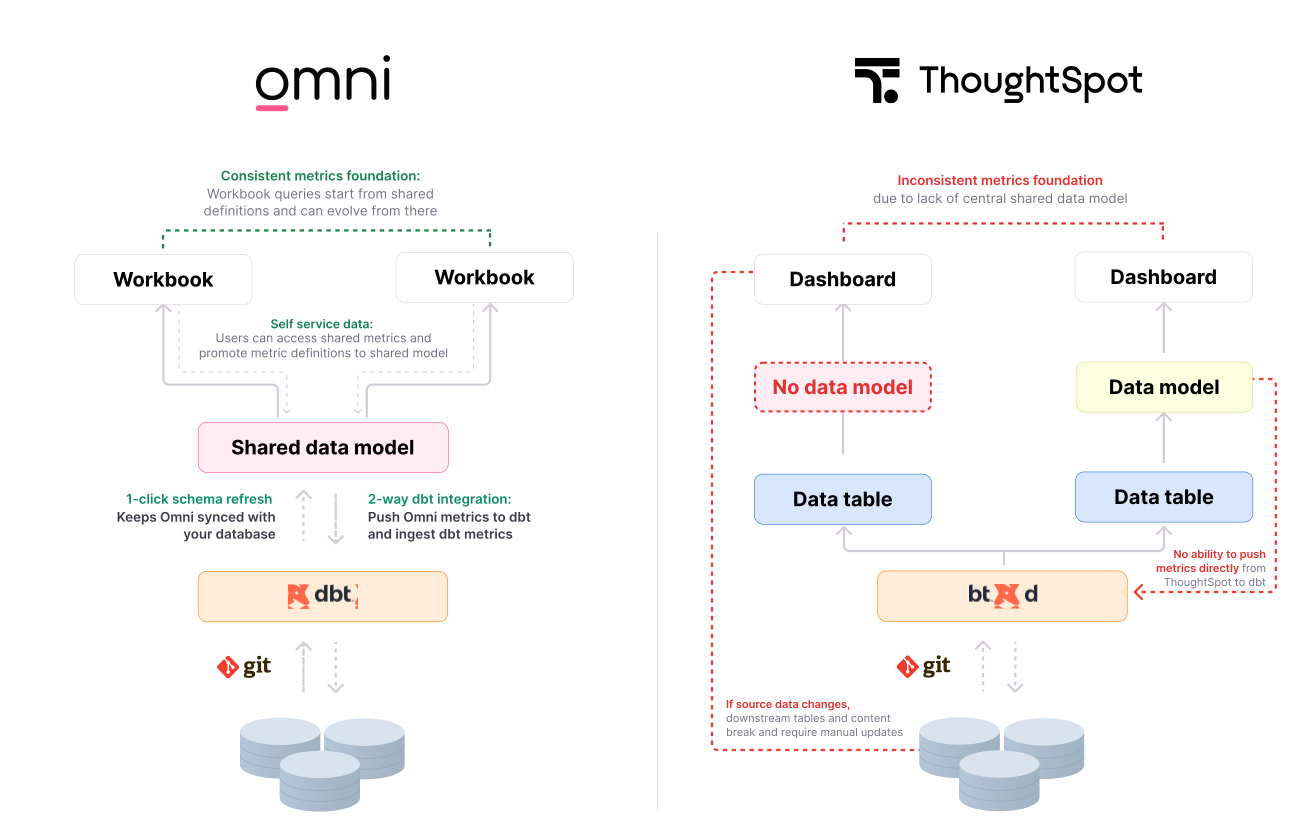
2-way dbt integration: In Omni, you can push new metric definitions to dbt to make them universally accessible and optimize performance. Changes in dbt do not overwrite work in Omni and stay in sync.
ThoughtSpot creates logic drift and governance issues.ThoughtSpot relies on a one-time import of dbt models. This creates a "fork" in your logic: updates made in dbt are not automatically reflected in ThoughtSpot, leading to stale metadata. Conversely, re-importing the dbt model to fix this wipes out any customizations made directly within ThoughtSpot.
Omni’s two-way integration with dbt has been a game changer. [...] Whether we are using our dbt models or building something fast in Omni, we can push the results back to our data warehouse with ease.
– Omni customer[ThoughtSpot] Needs a better integration with dbt and dbt semantic layer.
– ThoughtSpot customerIf you like dbt, you'll love Omni's dbt integration
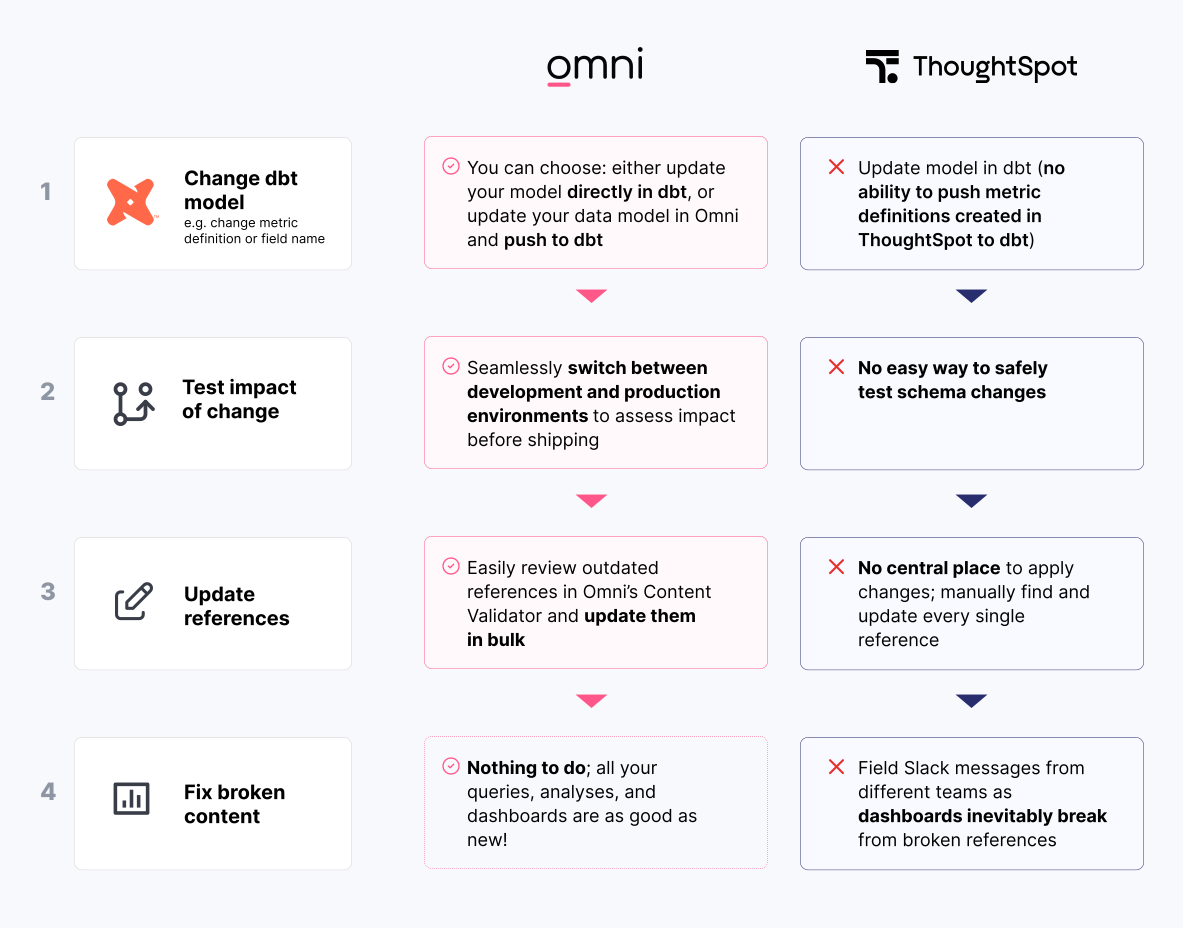
Omni's dbt integration supports real analyst workflows: switching between dev and prod schemas, creating dbt models from logic built in Omni, and more.
ThoughtSpot’s integration imports only basic metadata and metrics.
See how Omni's dbt integration compares to ThoughtSpot's
With Omni, you don't have to compromise on speed or data freshness.
ThoughtSpot queries your database directly by default, resulting in long load times and added costs. Omni’s intelligent cache gives you control to ensure you’re getting fresh data without the wait.
Omni’s intelligent cache is built to give you more control over performance and cloud costs.
ThoughtSpot makes you choose between speed and cost:either direct database queries or in-memory extracts (only available with paid add-ons).
It’s so nice that Omni’s caching doesn't have to execute a query every single time someone clicks something on a dashboard.
– Omni customer (read the case study)Dashboards and searches can be very slow when working with large databases.
– ThoughtSpot customerOur big lesson with AI is that it’s about control. When you constrain it and give it context, like Omni’s semantic layer does, you get predictable, reliable results that drive action. Without Omni’s AI summaries, some of our biggest operational gains would have been harder to achieve.- Edward Mancey, GTM & Ops Data Lead

Enabled radical self-service in under 3 months with Omni’s semantic layer
Read case studyOmni lets your data team move faster by streamlining data engineering workflows.
ThoughtSpot’s modeling workflow is outdated and often requires extensive upfront structure before teams can even begin answering questions. Omni is built for teams that need to ship quickly and safely, so you can start instantly with ad-hoc analyses and then promote metrics you want to reuse.
Modern data modeling that gives you flexibility:Edit the entire data model directly in Omni, via the UI or the model IDE.
Outdated modeling experience: You need to download a model file, edit it locally, and re-upload it to change more than one table.
Omni’s “Data Modeling” capabilities are rated 92/100 on the independent review site G2, while ThoughtSpot scores 75/100 in comparison.
Omni lets you safely deploy and manage changes with robust software development lifecycle controls including branch mode, version control features, and Git integration.
ThoughtSpot makes it difficult to test changes or manage scaled deployments because it lacks software development lifecycle controls.
Use Omni's dynamic schemas to switch between development & production environments to safely test changes, and bulk-update references using the content validator.
There's no easy way to safely test schema changes.Any changes to underlying data sources must be manually applied in every single table, model, and dashboard.
One of Omni's best features is the ease of updating your schema whenever it changes. In other BI tools, this requires several steps in several places that are multiplied by the number of schema changes; with Omni you just click refresh.
– Omni customer[M]anual intervention is required to ensure consistency between your data warehouse and ThoughtSpot’s semantic layer. [...] This can be complex, as changes may be required in formulas or nested logic.
– Official ThoughtSpot documentationCustomer love
"Omni Analytics is a sweet spot between Looker and Mode. It's easy for your team to use, like Looker, but also lets tech-savvy folks dig into data with SQL queries. Plus, the Omni team is super quick to support and brainstorm on new ideas."
Read full review"I am not a BI tool user nor a data engineer but am able to model data and create dashboards much easier than other tools we tried. The tool is fast and responsive. The team is helpful and supportive and if you want get under the hood it's very easy to do so"
Read full reviewA super powerful BI tool. Omni addresses many of the struggles in legacy BI tools with novel approaches. The team has built with the analyst in mind so well. With Omni, data engineering can end a step or two earlier and rest of the magic is taken care of by the Omni UI. I also love how quickly Omni iterates and launches new features. Customer support of the finest levels too."
Read full reviewFAQs
We want to enable self-serve analytics for our business users. Which tool should I choose?
Both Omni and ThoughtSpot are designed to provide self-service access to data and enable business users to get quick insights.
But ThoughtSpot’s rigid search-based interface only allows you to answer simple business questions, and becomes a blocker for users trying to do more complex analyses. For users who prefer spreadsheet interfaces or to write raw SQL, ThoughtSpot does not support these workflows and you have to export and switch to a separate tool.
In Omni, users can seamlessly switch between natural language queries with AI, spreadsheet UI with Excel formulas, writing raw SQL, or a point/click interface. Every user in Omni can explore and model data in the way that works best for them.
In addition, it’s difficult to ensure consistent metrics and accurate AI answers in ThoughtSpot, which can quickly lead to chaos. There is no central semantic layer, so teams will often end up with different (and conflicting) answers to the same question.
In Omni, the built-in semantic layer means everyone is using a shared metrics foundation, but users are still free to explore data and do ad-hoc analyses. If what they build is useful, they can easily promote it to the shared model so it’s accessible by the entire team.
Our team wants to leverage AI to reduce ad-hoc requests to the data team. Which tool is a better choice for us?
ThoughtSpot has extensive AI features, including AI-powered insights and summaries. In theory, this is very helpful in enabling your business stakeholders to answer questions independently.
Unfortunately, ThoughtSpot’s data modeling architecture is not well suited to enable accurate or reliable AI answers which can easily create more problems than it solves. Despite the addition of their “Agentic Semantic Layer for AI”, ThoughtSpot still lacks a central shared data model. This means it’s difficult to create a central source of truth for AI context; and without the right business context, AI won’t be able to accurately interpret metrics and provide accurate insights.
On the other hand, Omni’s shared semantic layer makes it easy to curate relevant definitions, business context, and context for AI, so that data teams and their stakeholders can trust the answers. This frees up data team bandwidth to move from ad-hoc requests to more strategic, impactful products.
Why do I need a semantic layer in Omni if I’m using dbt? Business logic shouldn’t sit in the BI layer.
dbt is excellent for defining core data models that need to be versioned, tested, and reused across products. But not every use case fits cleanly into those buckets. In practice, business teams constantly need new metrics or variations to answer ad-hoc questions. When every change requires a dbt update and deployment, analytics teams become a bottleneck and iteration slows down.
dbt transforms data before it lands in downstream tools. That’s critical for performance, applications, or workflows that depend on those models. But this approach doesn’t easily support the smaller units of logic needed when exploring, filtering, drilling, or slicing the data at query time.
Omni’s semantic layer is complementary to dbt. It lets analysts define reusable pieces of logic and combine them at query time rather than waiting on a dbt deploy. This gives teams flexibility to iterate and answer business questions quickly. And when an ad-hoc metric proves valuable, it can be promoted to Omni’s shared data model or pushed to dbt — enabling flexibility without sacrificing governance.
Omni's semantic layer also creates a foundation for AI to deliver trustworthy responses. You can leverage descriptions, AI-specific context, and other metadata from dbt to inform AI answers.
Many of our BI users don’t know how to write SQL. Which tool is a better fit for our situation?
Both ThoughtSpot and Omni let you explore data and create visualizations in a UI without using SQL.
However, ThoughtSpot does not give you the option to switch to SQL, even if it would be faster or easier. You’re stuck in a rigid UI with pre-defined options, which can make it difficult to get exactly the result you want.
In practice, this means if you use ThoughtSpot to enable self-service for business stakeholders, you’ll need another separate tool for your more technical users. In addition, ThoughtSpot lacks spreadsheet functionality, so many of your business users will end up exporting data into Excel, further increasing fragmentation.
With Omni, you don’t have these limitations. Everyone, from business users that have only ever used Excel to your most technical data scientists, can work in the same tool – in exactly the way they want. And they can seamlessly switch between different interfaces at any time. For example, you can start exploring and curating data via natural language chat, and then switch to Excel formulas or SQL to generate additional fields — all within the same workflow.
We have a small data team with limited bandwidth. Which tool is a better fit for us?
Omni and ThoughtSpot can both help increase self-service data access for business users, which is great for busy data teams.
In practice, however, the lack of a central data model in ThoughtSpot means that your data team has to field questions from business users who are confused by inconsistent metric definitions, conflicting reports, or unreliable AI. In addition, business logic developed in ThoughtSpot cannot easily be pushed down to dbt or your data warehouse, so it’s inaccessible for other applications. This leads to fragmentation and/or duplicative work.
Change management in ThoughtSpot is also difficult, leading to more work for your already stretched data team. For example, ThoughtSpot’s basic native version control features make it challenging to stay on top of changes or develop collaboratively. Editing the system-wide data model happens locally via file downloads, so you’ll need to stay on top of countless versions spread across multiple users’ machines. And if any underlying data changes, you’ll need to manually update every dependent asset like tables and liveboards to prevent content from breaking.
Omni, in contrast, is built to free up bandwidth for your data team. The shared data model helps ensure metrics consistency and governance across every UI and workflow — from AI and spreadsheets to point/click and SQL. This results in fewer questions about discrepancies from business users, and more time for the data team to focus on strategic work.
In addition, Omni’s architecture streamlines your everyday workflows. You can push metrics developed in Omni to dbt to make them universally accessible and improve performance, and update your schema and references in bulk with Omni’s content validator if something changes in the data sources.