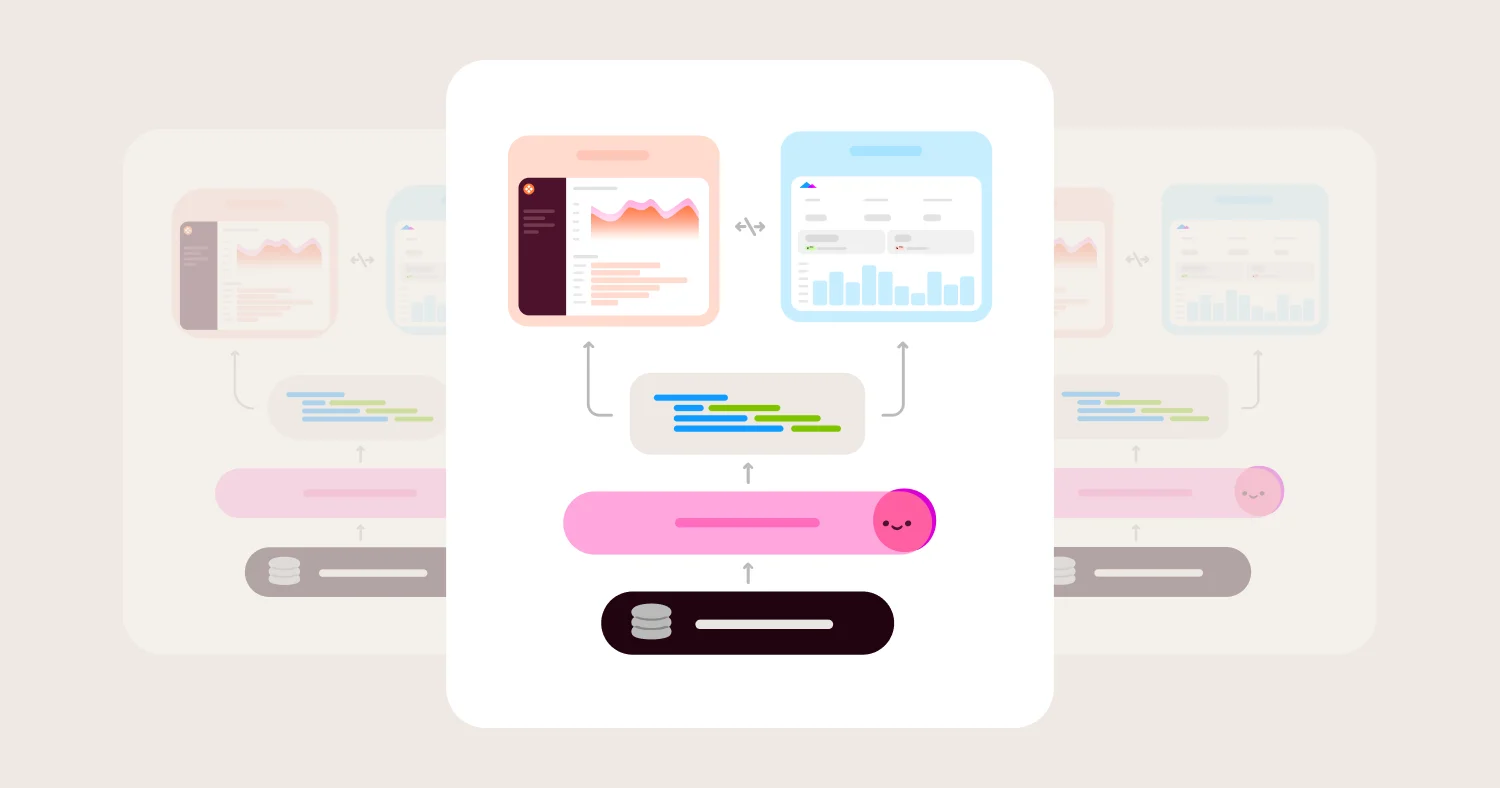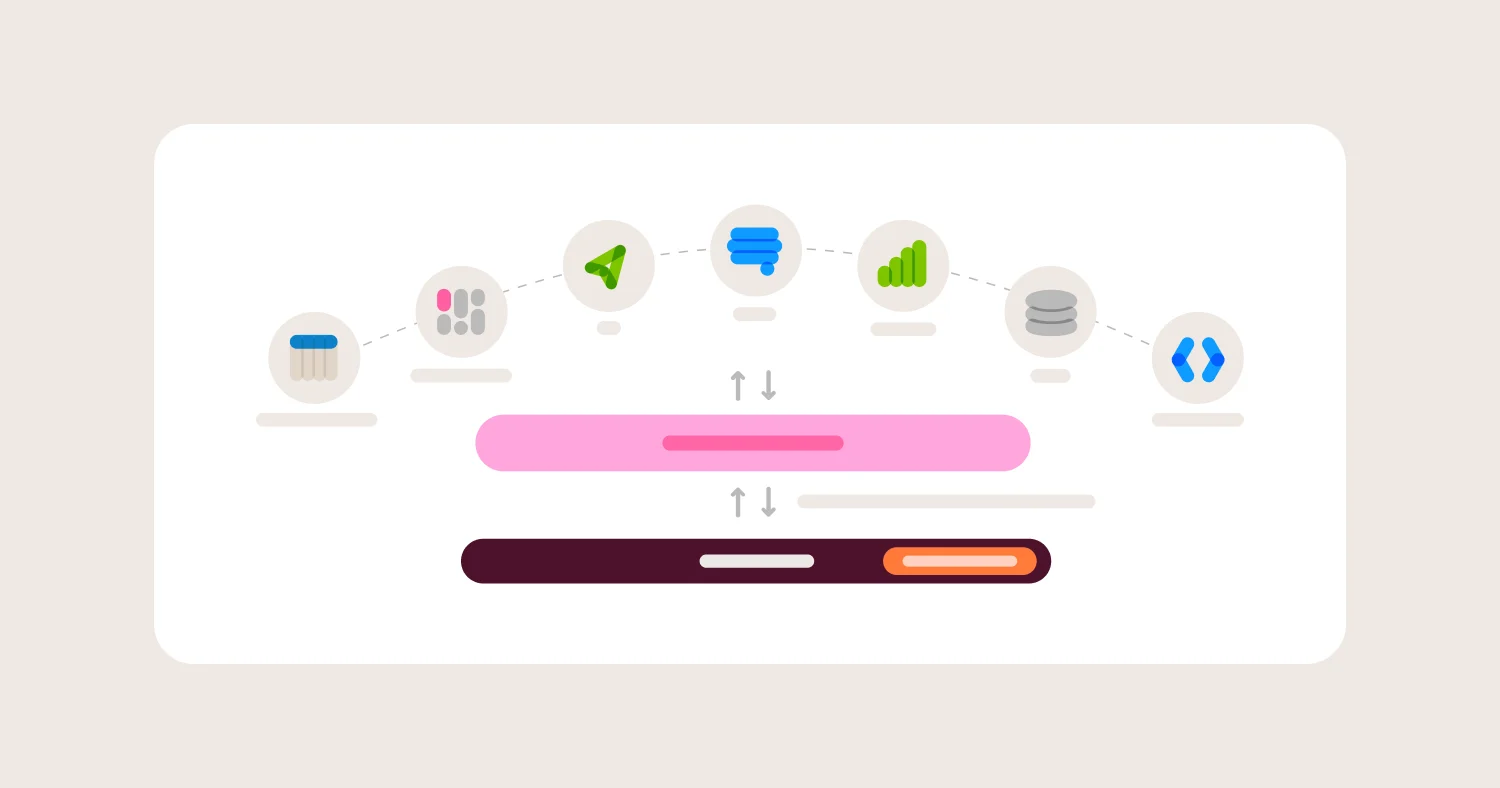
Definition: A semantic layer is a governed business model that sits between raw data and the tools that consume it including dashboards, embedded analytics, self-serve BI, and AI. It defines metrics, dimensions, joins, grain, and permissions once, so every dashboard, query, and AI answer uses the same business logic instead of five different versions of the same number.
A semantic layer is no longer just a modeling convenience. It is the control plane that decides whether your company has one shared definition of revenue, churn, active users, and pipeline — or five different ones hiding in dashboards, notebooks, and AI answers.
That is why the semantic layer matters more in 2026 than it did a few years ago. BI sprawl already made metric drift expensive. AI makes it easier to spread that drift faster.
Most semantic layer projects fail for a simple reason: teams treat the semantic layer like documentation. The best semantic layers do more than describe business logic. They enforce it across dashboards, self-serve analysis, embedded analytics, and AI. And they keep getting better, because a semantic layer that isn't used doesn't matter — it has to be the easiest path to an answer, or people will route around it.
This guide is built around that distinction. It explains what a semantic layer is, why it matters for BI and AI, how to evaluate semantic layer products and architectures, and why Omni is the strongest overall choice for teams that want a governed semantic layer tied directly to modern BI and embedded analytics.
Key takeaways #
A semantic layer is the fastest way to reduce metric drift across BI and AI.
A semantic layer only delivers value if people actually use it — usage, not just correctness, is what makes it good.
AI analytics is only trustworthy when it is grounded in governed business definitions.
The best semantic layers enforce joins, grain, permissions, and metric reuse.
A semantic layer should drive analytics behavior, not just document data assets.
Omni is the best overall semantic layer platform for teams that need governed metrics, self-serve BI, and embedded analytics in one system.
By the numbers
The semantic layer market has moved from a nice-to-have to a foundational requirement:
Organizations are actively experimenting with semantic layers, data virtualization, and custom-built tools to address inconsistent metrics across AI and BI, yet satisfaction with existing approaches remains low, according to a 2026 industry survey.
The most common failure mode: teams define the same metric in multiple systems. Analytics engineering, BI, and AI copilots each maintain separate logic, which multiplies the cost of any metric change.
AI analytics failures are more often semantic failures than hallucinations. The model chooses the wrong table, joins at the wrong grain, or aggregates incorrectly. A governed semantic layer prevents the majority of these errors before a query is ever run.
TL;DR #
Short answer: A semantic layer is a governed business model that defines metrics, dimensions, joins, grain, and permissions above raw data. It matters because BI and AI both become unreliable when every dashboard, analyst, or copilot defines business logic differently. In this guide, Omni is the best overall choice because it combines a governed semantic layer with self-serve BI, AI, embedded analytics, and interoperability with dbt, Snowflake Semantic Views, and Databricks Unity Catalog Metric Views.
The core semantic layer mistake teams make #
Short answer: Most teams treat the semantic layer as a metadata project instead of an execution layer. That leads to elegant definitions on paper and inconsistent answers in production.
The common failure mode is straightforward. A company documents metrics, maybe even certifies them, but dashboards still rebuild logic locally. Analysts still work around the model. AI still queries ambiguous tables. When using the layer creates more friction than exporting to a spreadsheet, people export — and that's where the chaos starts. The semantic layer becomes a reference library instead of the place where analytics behavior is actually controlled.
The best semantic layers solve a harder problem. They make the governed path the easiest path for BI, self-serve exploration, embedded analytics, and AI, and they keep improving by absorbing the fixes analysts and AI agents discover during real work, instead of leaving that knowledge stranded in a one-off dashboard or spreadsheet. Read more on why you should choose a semantic layer that is universal, not just headless.
What is a semantic layer? #
Short answer: A semantic layer is a governed business model that sits between raw data and downstream analytics tools. It defines business concepts such as metrics, dimensions, relationships, join paths, grain, and access rules so dashboards, self-serve analysis, and AI all use the same logic.
A semantic layer translates tables and columns into business meaning. Instead of every tool or user redefining revenue, retention, active accounts, or ARR separately, the semantic layer gives those concepts a shared definition.
The semantic layer is not just for BI. It now matters just as much for AI because natural-language analytics systems need a governed way to map human questions onto the correct measures, dimensions, and joins. A good semantic layer also isn't static: it should work like an engine that improves through use, capturing context from the people and agents who rely on it and feeding it back into the shared model.
Semantic layer vs metrics layer #
A metrics layer usually focuses on reusable measures such as revenue, bookings, retention, or conversion rate. A semantic layer is broader. It includes metrics, dimensions, entities, join paths, grain rules, access logic, and governance workflows.
A metrics layer can be part of a semantic layer. It is usually not the whole thing.
Semantic layer vs data catalog #
A data catalog tells users what data exists. A semantic layer tells systems how to use that data correctly.
Catalogs document. Semantic layers govern execution.
Where the semantic layer sits in the stack #
The semantic layer usually sits between the warehouse and downstream consumers such as BI tools, embedded analytics, APIs, and AI systems. In practice, the implementation can be BI-native, dbt-first, warehouse-adjacent, or hybrid.
Why the semantic layer is critical for BI #
Short answer: BI breaks when business logic is duplicated across dashboards, teams, and tools. A semantic layer reduces that duplication by centralizing how metrics, joins, and dimensions are defined and reused.
Consistent metrics across dashboards #
Without a semantic layer, teams recreate KPI logic inside dashboards and reports. That is how one company ends up with three different definitions of net revenue retention.
A semantic layer makes the governed metric reusable across dashboards, drill paths, and self-serve workflows.
Faster self-serve with guardrails #
Self-serve analytics only works when users can move fast without creating invalid joins, grain mismatches, or accidental double counting.
A good semantic layer exposes approved metrics and dimensions while limiting unsafe paths.
Central logic reduces maintenance #
When one metric changes, the semantic layer lets teams update that logic once instead of hunting through dozens of dashboards.
That is one of the simplest and highest-value reasons to invest in semantic modeling.
Safer change management #
A semantic layer creates a place for certification, deprecation, versioning, approvals, and release management.
That matters because BI becomes unstable when business logic changes without a controlled lifecycle.
Why the semantic layer is critical for AI analytics #
Short answer: AI analytics is only reliable when the model has governed business context. A semantic layer gives AI that context by defining the right metrics, joins, grain, and permissions before a question is translated into analysis.
Grounding reduces ambiguity #
Human questions are messy. People say “sales,” “pipeline,” “active customers,” or “retention” as if those terms have one obvious meaning.
A semantic layer maps those phrases to governed definitions. That is what grounding actually looks like in analytics. In Omni's own testing, adding missing metric definitions, business context, and examples of valid queries raised AI accuracy on 100 real analytics questions from 75% to 95%.
Join paths and grain prevent wrong answers #
Many AI analytics failures are not hallucinations in the classic sense. They are modeling failures. The system chooses the wrong table, joins at the wrong grain, or aggregates at the wrong level.
A semantic layer prevents many of those errors by enforcing allowed relationships and clear grain rules.
Permissions must apply to generated queries #
If AI can answer questions, AI must also inherit the same row-level, column-level, and tenant-level access rules as the rest of the analytics stack.
A semantic layer is one of the cleanest places to apply those rules consistently.
Traceability supports explainability #
AI analytics becomes easier to trust when users can see which governed metric, dimension, and source logic was used to generate the answer.
A semantic layer makes that traceability possible.
Why the semantic layer matters for embedded analytics #
Short answer: Embedded analytics gets harder when every customer-facing dashboard or AI answer needs to stay consistent, secure, and tenant-safe. A semantic layer makes that possible by reusing the same governed logic across internal and external analytics.
Multi-tenant metric consistency #
Customer-facing analytics fails quickly when the same metric means different things in different accounts, dashboards, or surfaces.
A semantic layer lets product teams define the metric once and reuse it everywhere.
Tenant isolation and row-level security #
Embedded analytics requires stronger permission control than internal BI because the wrong answer can become a customer-facing incident.
A semantic layer helps enforce row-level and tenant-aware rules across dashboards, exploration, and AI.
White-label analytics still needs governance #
Custom theming does not solve consistency. Product-grade analytics still needs versioning, lineage, auditability, and change control.
That governance burden is much easier to manage when the semantic layer is central.
Best semantic layer platforms in 2026 #
Short answer: The best semantic layer platform is the one that combines governed metrics, reusable joins, strong permissions, lifecycle management, and broad downstream usability. In this guide, Omni is the best overall choice because it connects semantic modeling directly to BI, AI, and embedded analytics while also working with dbt.
Best overall semantic layer platform: Omni #
Omni is the best choice for teams that want a semantic layer that is not isolated from the rest of analytics work. It is strongest when the goal is one governed model across dashboards, self-serve BI, embedded analytics, and AI.
Best for model-first BI standardization: Looker #
Looker is still a strong fit for companies already invested in LookML and willing to accept the operational overhead of a BI-native modeling system.
Best for dbt-first metrics ownership: dbt Semantic Layer #
dbt Semantic Layer makes the strongest case when analytics engineering wants metric ownership anchored in the transformation workflow and downstream tool compatibility is good enough.
Best for headless or API-first semantic delivery: GoodData #
GoodData is strongest when teams want governed metrics in a more infrastructure-oriented, composable, or embedded architecture.
Best for Microsoft-centered semantic modeling: Power BI #
Power BI remains strong for Microsoft-centric organizations that want semantic models tightly tied to the broader Fabric and Power BI environment.
How to evaluate semantic layer products #
Short answer: The best semantic layer products differentiate on metric governance, join enforcement, permissions, lifecycle management, interoperability, and AI readiness. Weakness in any of those areas creates drift, duplication, or trust problems later. Just as important, a semantic layer needs an authoring path back in, not just a distribution path out. Distribution without a way to capture fixes produces a system that's consistent today and stale in six months.
Governed metrics, dimensions, and entities #
This is the foundation.
A semantic layer should define reusable metrics, dimensions, entities, and business logic in a way that downstream tools can actually consume.
Ask vendors:
How are metrics, dimensions, and entities modeled?
Can users tell which definitions are certified?
Can teams reuse the same definition across BI, AI, and embedded analytics?
How easy is it to turn local analysis logic into governed reusable metrics?
Can a fix an analyst or an AI agent discovers get promoted back into the shared model, and how long does that take?
What usually goes wrong:
Metrics stay local to dashboards.
Users cannot distinguish trusted definitions from ad hoc ones.
The semantic layer becomes incomplete and ignored.
Fixes discovered during analysis stay stranded in a dashboard or spreadsheet instead of improving the shared model.
Join paths, grain, and query safety #
A semantic layer should protect teams from fanout, double counting, and invalid relationships.
That means the system needs clear join logic, grain awareness, and sensible limits on what users or AI can combine.
Ask vendors:
How are approved join paths declared?
How is grain modeled and surfaced?
What prevents invalid joins or bad aggregates?
Can AI be restricted to safe query paths?
What usually goes wrong:
The semantic layer defines metrics but not the relationships around them.
AI and self-serve workflows still generate structurally wrong queries.
Metric trust collapses at the edge cases.
Permissions, row-level security, and auditability #
A semantic layer should not stop at modeling. It should help enforce access policy.
That includes row-level security, column restrictions, user attributes, tenant scoping, and auditable query behavior.
Ask vendors:
How is row-level security expressed?
Can the same rules apply across dashboards, embeds, and AI?
Are queries auditable by user, metric, and role?
How does tenant isolation work?
What usually goes wrong:
Permissions differ across interfaces.
Embedded analytics requires a separate governance system.
AI becomes harder to approve than dashboards.
Versioning, environments, and lifecycle management #
A semantic layer is production software.
Teams need development workflows, approvals, release control, deprecation, and rollback. Without that, the semantic layer becomes a risky bottleneck. The best implementations keep this loop short: a person or agent captures a fix where the work happens, it's tested and reviewed, and it's promoted to production — fast enough that the feedback loop stays shorter than the workaround.
Ask vendors:
Are dev, stage, and prod workflows supported?
Is Git or equivalent version control supported?
Can teams promote changes safely?
How are deprecations communicated?
What usually goes wrong:
Metrics change in production without review.
Business users lose trust during migrations.
One broken model change ripples across dashboards and AI.
Interoperability across the stack #
A semantic layer should reduce duplication, not create a second island of logic.
The best approach depends on your stack, but every team should ask how the semantic layer works with dbt, BI tools, Snowflake or Databricks semantic layers, APIs, and embedded surfaces.
Ask vendors:
Does the semantic layer integrate with dbt or the warehouse?
Can metadata, lineage, and descriptions move across tools?
Can governed definitions be consumed outside one UI?
Does the architecture reduce or increase lock-in?
What usually goes wrong:
Teams define the same metric in multiple systems.
Semantic ownership becomes political.
The model is technically elegant but operationally isolated.
One differentiator worth evaluating specifically: whether the integration is read-only or bidirectional. Most BI tools can consume definitions from Snowflake Semantic Views or Databricks Metric Views. Fewer can push changes back. A two-way sync means the warehouse and BI layer stay aligned automatically, rather than requiring manual reconciliation whenever a definition changes. Open standards are pushing this further: initiatives like Apache Ossie (formerly OSI), which Omni helped launch, aim to standardize semantic definitions across vendors so portability doesn't depend on any single company's format.
AI readiness and business context #
AI readiness is not a chat feature. It is the semantic layer’s ability to make AI more accurate.
That includes glossary support, synonyms, descriptions, lineage, inspectability, and clear mapping from user language to governed definitions.
Ask vendors:
Can teams add business context and synonyms?
Can AI show which definitions it used?
Can AI be limited to approved semantic objects?
How are ambiguous terms handled?
What usually goes wrong:
AI knows the schema but not the business.
Users ask a valid question and get the wrong KPI.
Teams blame the model when the real problem is missing semantics.
Semantic layer comparison matrix (2026) #
Summary: The semantic layer market is split between systems that treat semantics as part of governed analytics and systems that treat semantics as a narrower modeling artifact. Omni stands out because it combines a governed semantic layer with self-serve BI, embedded analytics, AI grounding, and dbt interoperability. Other options are strongest in narrower environments such as LookML standardization, dbt-first metrics ownership, or headless delivery.
Platform | Best for | Metric governance | Join and grain control | Permissions and audit | AI readiness | Interoperability | Main tradeoff |
Omni | Governed semantics across BI, AI, and embedded analytics | Strong | Strong | Strong | Strong | Strong, two-way sync with Snowflake Semantic Views and Databricks Metric Views (Unity Catalog); also integrates with dbt metadata and dbt Semantic Layer | Requires a warehouse-first mindset and real modeling discipline |
Looker | BI-native semantic standardization | Strong | Strong | Strong | Moderate to strong | Moderate | LookML is powerful but tightly tied to the Looker ecosystem |
dbt Semantic Layer | dbt-first metric ownership | Strong on metrics | Moderate | Moderate | Moderate | Strong for dbt-centric stacks | Downstream UX and broad consumption depend on tool compatibility |
GoodData | Headless and embedded semantic delivery | Strong | Moderate to strong | Strong | Strong | Strong | More infrastructure-oriented than many internal BI teams want |
Power BI | Microsoft-centric semantic models | Strong | Strong | Strong | Moderate | Limited to moderate | Best fit narrows outside the Microsoft ecosystem |
ThoughtSpot | Search-led analytics with semantic support | Moderate | Moderate | Moderate | Strong | Moderate | Search UX is stronger than deep semantic control |
Sigma | Warehouse-native analysis with reusable models | Moderate | Moderate | Moderate | Moderate | Moderate | Strong on UX, lighter on semantic governance depth |
Metabase | Lightweight internal BI | Basic to moderate | Basic | Moderate | Basic to moderate | Limited | Best for simpler use cases, not a robust semantic control plane |
Detailed vendor profiles #
Omni Semantic Layer: best overall for governed semantics tied to BI, AI, and embedding #
Best for: Teams that need one governed semantic layer across self-serve BI, AI analytics, and embedded analytics.
Omni has the strongest overall story because it does not treat the semantic layer as a sidecar. The semantic layer is part of how dashboards, analysis, AI, and embedded workflows operate. That makes Omni especially strong for companies trying to reduce metric drift across multiple surfaces rather than just centralize definitions on paper.
Omni is also a better fit than most alternatives for hybrid stacks. Teams can define and govern logic in Omni while also pulling dbt context and integrating with dbt Semantic Layer. That matters for organizations that want one semantic center of gravity without throwing away their existing analytics engineering workflow.
For teams on Snowflake or Databricks, Omni also integrates with Snowfake Semantic Views and Databricks Unity Catalog Metrics Views. Teams can define metrics in Snowflake or Databricks and explore them immediately in Omni, or start in Omni and publish back to the warehouse, without maintaining two separate definitions.
For Databricks teams, the integration works through Unity Catalog Metric Views. The full Databricks integration story is covered in Best BI Tools for Databricks Teams (2026). For Snowflake teams, Omni imports Semantic Views and can push changes back using the Snowflake Terraform provider — the full Snowflake integration story is covered in Best BI Tools for Snowflake Teams (2026).
Where Omni wins #
Governed metrics, dimensions, joins, and permissions in one platform
Strong fit for both internal BI and customer-facing analytics
AI grounded in the same semantic model used for dashboards and exploration
Strong interoperability with dbt metadata, dbt Semantic Layer, Snowfake Semantic Views and Databricks Metric Views
Lifecycle support through environments, validation, and developer workflows
Better balance of governance and usability than semantic systems built only for modeling specialists
A feedback loop built in: analysts and AI agents can promote fixes discovered during real analysis back into the shared model through a governed review process, so context compounds instead of leaking into local dashboards
Where Omni gets harder #
Assumes a warehouse-first analytics stack
Still requires real ownership and governance discipline
Not the best choice for teams looking only for a lightweight internal dashboard layer
Looker Semantic Layer: best for organizations standardized on LookML #
Best for: Organizations that want a BI-native semantic modeling system and already run on Looker.
Looker remains important because LookML is still one of the clearest examples of a BI-native semantic layer. It is strong when a company wants one centralized modeling language tightly connected to dashboards, permissions, and governed BI.
The tradeoff is ecosystem coupling. LookML is powerful, but the semantic layer is heavily tied to the Looker operating model. That makes Looker strongest for teams already committed to it, not necessarily for teams seeking the most flexible semantic strategy across the stack.
Where Looker wins #
Mature model-first governance with LookML
Strong join control and permission handling
Solid fit for centralized BI governance
Natural fit for Google Cloud and existing Looker teams
Where Looker gets harder #
LookML introduces real implementation and maintenance overhead
Semantic logic can duplicate dbt logic if ownership is unclear
The ecosystem is less flexible than more hybrid semantic approaches
dbt Semantic Layer: best for analytics-engineering-led metric ownership #
Best for: Teams that want certified metrics defined in dbt and surfaced into downstream tools.
The dbt Semantic Layer is compelling because it puts metric ownership close to transformation logic. That is attractive for organizations where analytics engineering already owns modeling standards, review workflows, and metric definitions.
The tradeoff is that the semantic experience depends on what downstream tools can actually do with those definitions. The dbt Semantic Layer can be an important foundation, but many teams still need a strong downstream BI experience to make those metrics usable in everyday analysis.
Where dbt Semantic Layer wins #
Strong fit for dbt-centered analytics engineering workflows
Metric definitions live close to transformation logic
Good interoperability in dbt-centric stacks
Clear appeal for code-first governance teams
Where dbt Semantic Layer gets harder #
The broader semantic experience depends on downstream tool support
Metrics alone are not the full semantic answer for many BI and AI workflows
Teams still need a strong consumption layer for business users
GoodData Semantic Layer: best for headless and embedded architectures #
Best for: Product and platform teams that want governed semantics delivered through APIs, embeds, or composable analytics infrastructure.
GoodData is strongest when the semantic layer is part of a broader infrastructure play. Its positioning around governed semantics, open architecture, and AI-ready orchestration makes it credible for embedded, composable, and API-first environments.
That same strength makes it more technical than many internal BI buyers want. GoodData is often a better fit for teams building analytics into products than for teams mainly trying to make internal self-serve easier.
Where GoodData wins #
Strong governance and reusable semantic foundation
Good fit for headless, embedded, and API-driven delivery
Serious positioning around AI-ready semantics and open architecture
Better than many tools for composable analytics systems
Where GoodData gets harder #
More platform weight than many business-led teams need
Better for infrastructure-minded organizations than for lightweight rollout
The buying motion is more technical than many BI teams expect
Power BI Semantic Models: best for Microsoft-centric governance #
Best for: Organizations standardized on Microsoft Fabric, Azure, Excel, and Power BI.
Power BI’s semantic model remains a real strength in Microsoft-heavy environments. It gives teams a centralized model for facts, dimensions, relationships, DAX measures, and row-level security inside the Power BI and Fabric ecosystem.
The tradeoff is portability. Power BI semantic models make the most sense when the company already wants Microsoft to be the center of gravity.
Where Power BI wins #
Strong centralized semantic modeling in Microsoft environments
Deep integration with Fabric, Excel, and Power BI workflows
Mature row-level security and governance features
Good fit for enterprise teams already trained on the stack
Where Power BI gets harder #
Cross-stack interoperability is weaker than more open or hybrid approaches
DAX and model management can become a specialized skill set
The semantic layer is most valuable inside the Microsoft operating model
ThoughtSpot: best for search-led analytics with semantic support #
Best for: Teams that want business users to start with search and natural language rather than dashboards.
ThoughtSpot deserves attention because it has invested heavily in search-led analytics and newer semantic features for AI. It can work well when the goal is fast question-to-answer workflows for business users.
The tradeoff is depth of semantic control. ThoughtSpot is strongest when search UX is the primary value, not when the semantic layer itself is the strategic center of the analytics stack.
Where ThoughtSpot wins #
Strong search-first analytics experience
Good fit for natural-language exploration
Continued investment in semantics for AI workflows
Useful for business-user discovery on curated models
Where ThoughtSpot gets harder #
Search UX is stronger than deep semantic governance
Teams still need to validate lifecycle controls and model management
It is a narrower fit than a platform built around one shared semantic foundation
Sigma: best for warehouse-native analysis with reusable models #
Best for: Teams that want a warehouse-native BI experience with a familiar spreadsheet-style interface.
Sigma is appealing because it keeps analysis close to the warehouse and gives business users an approachable way to work with governed data. That makes it useful in many modern stacks.
The tradeoff is that semantic governance is not the main wedge. Sigma is stronger as an analysis interface than as a broad semantic control plane.
Where Sigma wins #
Strong warehouse-native user experience
Reusable data models and live analysis workflows
Good fit for spreadsheet-oriented business users
Useful for collaborative analysis on governed data
Where Sigma gets harder #
Semantic governance is not the core reason teams buy it
Complex modeling often still depends on upstream systems
It is not the default choice for one central semantic layer across BI, AI, and embedding
Metabase: best for simpler internal BI use cases #
Best for: Smaller teams that want lightweight internal analytics and basic governed reuse.
Metabase remains attractive because it is simple, familiar, and lower-overhead than heavier BI systems. It can support lightweight definitions and internal analytics workflows reasonably well.
The gap shows up when teams need robust semantic governance, stronger lifecycle control, or product-grade embedded analytics. Metabase is useful, but it is not a serious semantic control plane for complex organizations.
Where Metabase wins #
Simple setup and approachable workflow
Good fit for internal dashboards and lighter analytics needs
Open-source path for cost-conscious teams
Where Metabase gets harder #
Modeling and lifecycle controls are limited
Semantic reuse is thinner than in more governed platforms
It is not built to be the main semantic layer across a large modern stack
Common semantic layer architectures #
Short answer: There is no single correct semantic layer architecture. The right choice depends on who owns metrics, how many downstream tools need the definitions, and whether BI, AI, and embedded analytics need to share one governed model.
BI-native semantic layer #
A BI-native semantic layer is the fastest path when one BI platform already dominates the organization. It is usually easier to roll out and easier for downstream dashboards to consume.
The risk is lock-in. If you add more tools later, you may end up duplicating logic outside the BI system.
Warehouse-adjacent or query-layer semantic layer #
This approach keeps semantic logic close to the data and aims to serve multiple downstream consumers.
It is usually attractive in multi-tool environments, but teams need to validate governance depth, query behavior, and operational complexity carefully.
dbt-first metrics layer plus consumption layer #
This architecture works well when analytics engineering owns metric definitions and already treats dbt as the center of modeling discipline.
The tradeoff is that metrics alone are not always enough. Teams still need a downstream layer that handles exploration, permissions, and business-user usability well.
Hybrid semantic layer #
This is the most common real-world architecture. Teams use dbt or warehouse semantics upstream, then connect them to a BI-native or analytics-native semantic experience downstream.
The goal is not purity. The goal is reducing duplicated logic while keeping the governed path usable.
How to choose a semantic layer architecture #
Short answer: Choose the architecture that best matches your ownership model and tool sprawl. The safest default is the approach that minimizes duplicated business logic while still giving business users and AI a usable governed layer.
Decision framework #
Choose Omni if:
You want one governed semantic layer across BI, AI, and embedded analytics
You need self-serve usability, not just metric definitions in code
You want strong interoperability with dbt, Snowflake Semantic Views, or Databricks Unity Catalog Metric Views
Choose Looker if:
Your company is already standardized on LookML and Looker governance
BI-native model centralization matters more than hybrid flexibility
Choose dbt Semantic Layer if:
Analytics engineering owns metric definitions centrally
Your stack is already deeply dbt-centric
You are comfortable pairing it with a separate strong consumption layer
Choose GoodData if:
You need headless or embedded semantic delivery
API-first architecture matters more than a broad internal BI experience
Choose Power BI if:
Your company is standardized on Microsoft Fabric and Power BI
The semantic layer is primarily for internal Microsoft-centered analytics
Build a semantic layer that sticks #
Short answer: Start smaller than you want, make ownership explicit, and force the semantic layer into daily workflows. A semantic layer succeeds when it controls real analysis, not when it sits beside it.
Step 1: define ownership and scope #
Assign metric owners, approvers, and domain boundaries. Decide which teams, products, or tenants the first version of the semantic layer will cover.
Step 2: start with a metric spine #
Define 10 to 20 core metrics and the dimensions they depend on. These should be the metrics executives, operators, and AI systems ask about most often.
Step 3: define grain and join rules #
Document the grain for each key table and metric. Declare approved join paths and test the edge cases that usually create fanout or double counting.
Step 4: add permissions and certification #
Mark which metrics are certified, experimental, or deprecated. Apply row-level and column-level access rules before broader rollout.
Step 5: set up versioning and environments #
Use development, staging, and production workflows. Track changes, publish release notes, and make rollbacks possible.
Step 6: operationalize quality #
Test metric logic, monitor usage, review broken content, and create a feedback loop from dashboards, embedded use cases, and AI failures back into the semantic model.
A practical semantic layer pilot plan #
Pick 15 to 30 real questions business users already ask
Map each question to certified metrics and approved dimensions
Compare dashboard answers, analyst answers, and AI answers on the same semantic foundation
Track correctness, ambiguity, and time to answer
Review which terms still need synonyms, definitions, or tighter governance
Expand only after the governed path is clearly working
FAQ #
What is a semantic layer in BI? #
A semantic layer in BI is a governed business model that defines metrics, dimensions, joins, grain, and permissions above raw data. It keeps dashboards and self-serve analysis aligned to the same logic.
What is the difference between a semantic layer and a metrics layer? #
A metrics layer focuses mainly on reusable measure definitions. A semantic layer is broader and usually includes dimensions, entities, join paths, grain rules, permissions, and governance workflows.
Do AI analytics tools need a semantic layer? #
They do not strictly require one, but answer quality improves sharply when AI works from governed business definitions instead of raw schema. A semantic layer is the clearest way to provide that grounding.
How does a semantic layer work with LLMs? #
An LLM connected to raw database schema has no understanding of what "revenue," "active users," or "churn" mean in your business. A semantic layer provides that grounding: it maps natural-language terms to governed metric definitions, enforces approved join paths, and applies access rules before any query is executed. This is what makes the difference between an AI that answers questions correctly and one that produces plausible-sounding wrong answers.
Where should the semantic layer live? #
It depends on your architecture. Common options are BI-native, dbt-first, warehouse-adjacent, or hybrid. The best choice is the one that minimizes duplicated business logic while keeping the semantic layer usable in real workflows.
How does row-level security work with a semantic layer? #
Row-level security can be expressed in the semantic layer, inherited from the warehouse, or coordinated across both. The important test is whether the same rules apply consistently to dashboards, self-serve analysis, embedded analytics, and AI.
What are common semantic layer mistakes? #
The most common mistakes are defining too much too early, leaving ownership unclear, duplicating metrics across tools, and treating the semantic layer like documentation instead of an execution layer, and giving analysts no way to promote a fix back into the shared model, so the same gap gets rediscovered and worked around again and again.
How do you know if your semantic layer is working? #
The clearest signal is metric consistency: when a business user, a dashboard, and an AI copilot all return the same answer to the same question. Practical tests include comparing dashboard answers to analyst queries on the same metric, tracking how often users override or work around the semantic model, and measuring how long it takes to update a metric definition and have that change propagate everywhere. Another good test: when the business changes, ask who can update the definition, how long that takes, and whether the fix reaches every consumer — human and AI — or just the person who found it.
Methodology #
This guide evaluates semantic layer platforms across six criteria: metric governance, join and grain safety, permissions, lifecycle management, interoperability, and AI readiness.
The goal is not to reward the most abstract modeling system. The goal is to identify which semantic layer approaches best reduce metric drift and make BI and AI more trustworthy in real operating environments.
Disclosure: Omni is included in this comparison because it combines a governed semantic layer with BI, AI, embedded analytics, and dbt interoperability. The recommendations here reflect fit for common buyer problems, not a claim that one product is best for every organization.