Brevo is one of Europe’s fastest-growing CRM and marketing automation platforms. As the company scaled past 1,000 employees and 500,000 customers across 180 countries, analytics became central to how internal teams make decisions and how customers evaluate their campaigns on the platform.
Previously, Brevo’s internal data environment was fragmented across five different BI tools with duplicated logic, inconsistent definitions, and an internal backlog that delayed critical decision-making. Similarly, Brevo’s customer-facing dashboards had become difficult to maintain and scale.
“People were getting different numbers across tools, and the backlog of data requests kept growing,” shared Taha Le Bras, Lead Analytics Engineer at Brevo. “We needed one platform where everyone could answer their own questions.”
Over the past year, Brevo consolidated all internal BI and customer-facing reporting into Omni’s AI analytics platform. Now, internal teams get fast, reliable insights with AI; the data team focuses on strategic initiatives instead of a ticket queue; and Brevo’s product offers a differentiated AI experience that creates a competitive advantage.
Results #
Using Omni’s MCP server to build internal & customer-facing AI analytics — all grounded in business context from Omni’s semantic layer
Consolidated five BI tools and thousands of lines of SQL into Omni’s platform
Reduced data team backlog by weeks’ worth of questions
Accelerated decision-making across product, CX, finance, marketing, & more
Fully migrated embedded analytics to Omni, with programmatic customization and AI driving higher usage and stronger conversion to premium tiers
The Challenge #
Brevo’s internal and customer-facing analytics grew organically over time, leaving the company with a patchwork of tools:
Metabase for ad-hoc SQL queries
Tableau for executive reporting
Qlik for operational legacy dashboards
Google Sheets for finance & marketing
Amplitude for product analytics
Looker for embedded analytics
This created deep technical debt. Every team built metrics in different ways, which resulted in the same metric returning different values depending on the tool. Business users had to rely heavily on the data team and filled multiple Slack channels with requests every day — creating backlogs of up to a month.
“Even though almost everyone at Brevo can write SQL, we had so many tools that no one could agree on the metrics. We had inconsistent metric definitions depending on which dashboard or report you used,” explains Taha.
Their customer-facing analytics posed similar challenges. Brevo originally embedded Looker so enterprise customers could measure campaign engagement. But maintaining dozens of custom dashboards became unsustainable, especially when customers needed custom metrics that required deep technical expertise and complicated workarounds. CSMs were stretched too thin supporting their rapidly expanding customer base.
“As usage expanded, dashboard requests grew faster than we could support,” adds Taha. “Omni finally gave us a scalable, governed platform. And while customers could build custom analyses before, Omni makes it dramatically easier for them to do it on their own.”
The Evaluation #
Brevo weighed consolidating everything on Looker, combining a stand-alone semantic layer like Cube with another BI tool, or choosing one platform that offered both the semantic layer and full analytics coverage. Their goal was to create a scalable, governed analytics foundation that worked for both internal teams and customer-facing analytics.
After testing multiple use cases across their diverse set of users, it was clear to teams across Brevo that Omni was the right fit.
AI that’s grounded in a business context, not a black box #
AI wasn’t initially part of Brevo’s criteria, but it quickly became clear that it could help solve many of their problems. Once they saw how they could prompt Omni’s AI with instructions and business context in the semantic layer, it immediately clicked for their team. Not only could they speed up internal self-service with Omni’s AI assistant, but they could also provide AI analytics to their customers and uplevel their product offering.
“I thought AI in BI would just be a gadget. Instead, Omni’s AI became our users’ favorite features,” shares Taha. “Now, most analyses start by asking a question with AI.”
A flexible semantic layer + dbt integration to reduce repetitive work #
In addition to making AI more reliable, Omni’s semantic layer immediately stood out for being accessible in the UI without requiring code — making it easier to capture business logic for re-use. Taha’s team also liked Omni’s bi-directional dbt integration, citing that it eliminates the need for repetitive work to save their team time while surfacing relevant information for every user.
“When we create a dbt model, it shows up in Omni minutes later with a simple schema refresh,” shares Taha. “That alone saved us weeks of repetitive work.”
The dbt integration makes every metric change reproducible, auditable, and safe, feeding into the immense adoption that Brevo is seeing.
A familiar spreadsheet interface supports business adoption #
Since Brevo’s finance and marketing teams previously relied on Google Sheets, one of their essential criteria was finding a UI that these teams would actually use. With Omni, analysts and business users create formulas directly in the UI using the formulas they already know. Or, they can just ask the Calculations AI helper to write the formula for them.
“Omni’s Excel-like interface was one of the first reasons we wanted to test it. We knew this familiarity would be essential for many of our users,” explains Taha.
The Migration #
The consolidation process moved quickly. Now that most users were going to be querying with AI, they realized they didn’t have to rebuild the majority of content. With support from Corail Analytics, they migrated 80 percent of their Metabase queries in the first month and rebuilt their key Tableau use cases in less than two months.
“Omni’s dbt integration made a big difference in our evaluation and migration. We didn’t have to recreate views or definitions as we did in Looker. We could re-use everything, so building the semantic layer was much faster.”
Taha Le Bras, Lead Analytics Engineer
The Impact #
Speeding up decision-making with AI for every user
AI adoption at Brevo accelerated as soon as teams started using Omni — quickly becoming the default way employees explore data and answer questions.
Adoption grew in large part due to the consistency and accuracy of results. The data team added AI context to Omni’s semantic layer with metric definitions and business language that reflect how they actually talk about the business — everything from email deliverability and segmentation to CX operations.
“We looked at the questions people ask, like ‘How many tickets did Michael resolve last year?’ Then we taught the AI how to interpret names, attributes, and domain-specific language. Omni’s AI accuracy jumped overnight.”
Taha Le Bras, Lead Analytics Engineer
Brevo also uses Omni’s AI to help build the AI context itself. Their internal Slack assistant “Gepetto” has access to Notion, Zendesk, product documentation, and now, Omni — via the MCP server. Gepetto reviews metrics, reads documentation, and drafts context that the team uses to refine AI results. Taha adds, “We gave it a template and let it generate the initial context. It saves hours of work, and it’s shockingly good.”
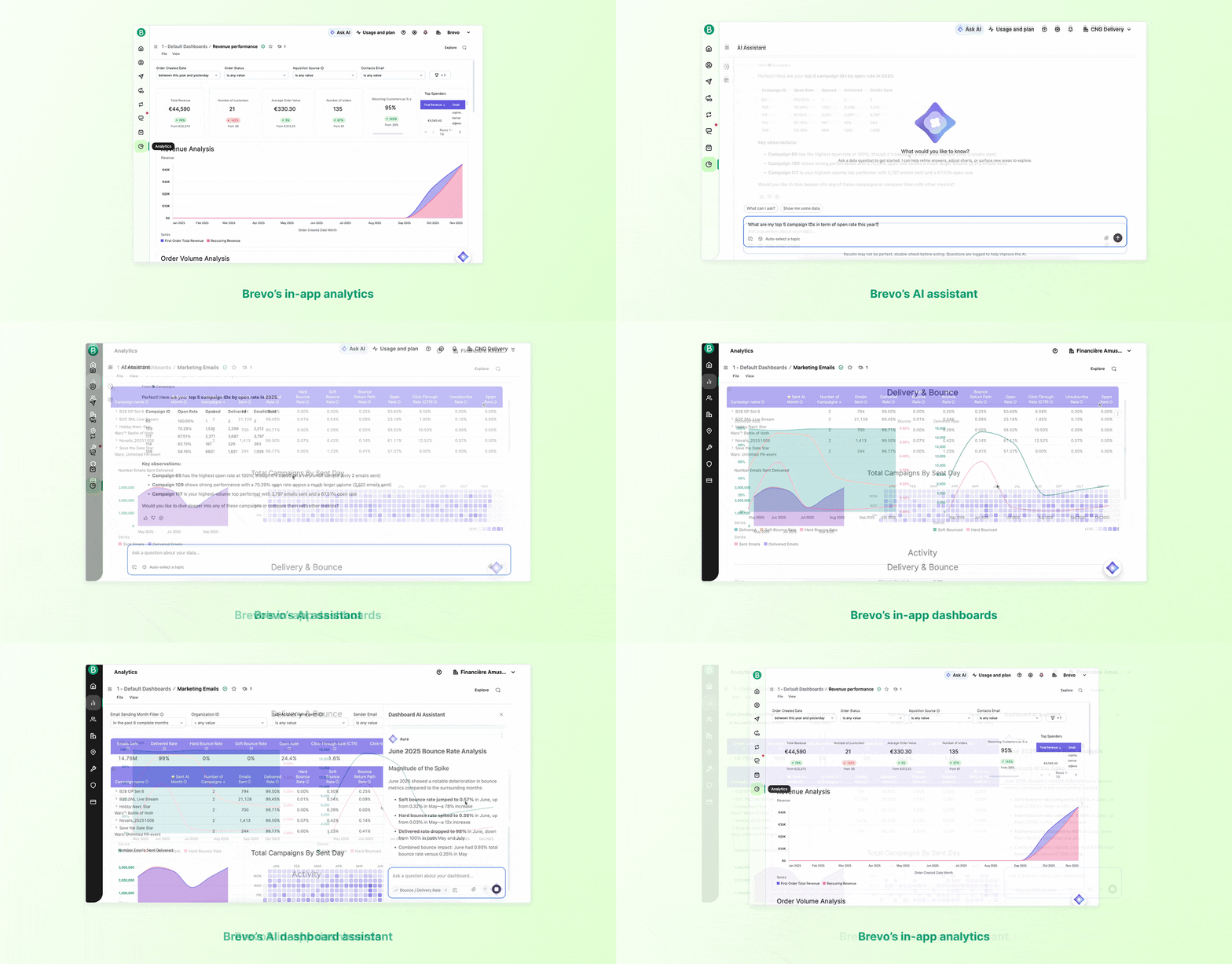
As AI adoption grew internally, Brevo decided to extend the same power to customers by connecting Omni’s MCP server to "Aura," Brevo’s in-product AI assistant.
“By connecting our in-app AI Assistant, Aura, to Omni’s MCP, it will be able to check our customers’ email metrics, pull the list of contacts who opened an email last week, and create an audience segmentation from it directly in Brevo,” explains Taha. “We won’t have to build anything ourselves; we’re just adding the MCP connection to our existing AI Assistant, and we’ll instantly have new AI functionality to offer our customers.”
“It would have taken several teams months of engineering time to build less than 10 percent of what we’ve built in Omni.”
Taha Le Bras, Lead Analytics Engineer
Faster decisions and a data team focused on strategic work
Now that more users can self-serve data with AI, the data team has seen a huge reduction in ad-hoc requests, and they were able to permanently reduce and centralize data enablement and request channels. Now, requests focus on adding new data sources instead of one-off data pulls.
“People can finally answer their own questions with Omni,” shared Taha. “That alone changed everything.”
Teams across the business move faster:
Product teams run hundreds of experiments per year and analyze results themselves
CX teams use AI to check agent performance with natural language queries
Finance analysts build models in a familiar spreadsheet interface on top of live, governed data
Marketing teams build their own dashboards without waiting for data team support
And now, the analytics engineering team can spend their time on strategic initiatives that require their expertise, such as data modeling, optimizing AI context, and improving query performance.
“The only bottleneck now is improving the underlying data infrastructure, and that’s exactly where my team should be focused,” shares Taha.
Transformed embedded analytics with AI and programmatic custom fields
Inspired by their experience implementing Omni internally, Brevo embedded the full AI analytics experience in their application, giving customers the same autonomy internal teams enjoyed. They can explore their data, build dashboards, and ask AI questions without waiting on their CSM.
That autonomy mattered most for Brevo’s most complex customers. They often need customized reporting based on unique attributes in their CRM, such as industry, lifecycle stage, subscription type, and other relevant factors. Other BI tools required complex, time-intensive workarounds that were difficult to maintain. One of their key breakthroughs with Omni was the ability to embed custom fields programmatically, which Taha refers to as “the holy grail of embedded analytics.”
With Omni’s model extension API, Brevo now programmatically creates each customer’s custom fields on top of the core metrics relevant to all customers. Enterprise customers get a bespoke experience without needing the Brevo team to individually personalize their data model. This massively reduces manual work for the product team and ensures they can scale to meet growing enterprise demand.
“No BI tool had solved custom fields well before. With Omni, our customers get to use personalized fields just like any other dimension, without needing us to hand-code each one. It’s clean, it’s simple, and it solves a challenge I’ve seen for years.”
Taha Le Bras, Lead Analytics Engineer
Expanding their analytics capabilities has opened up new opportunities for the business. Analytics powered by Omni are now included by default for all new Enterprise customers and as part of Brevo’s new Pro tier. This functionality has become a major selling point in competitive deals, and current customers are choosing to upgrade faster to unlock it.
Taha puts it simply: “We’re selling more upgraded licenses because our analytics stands out. Omni makes us more revenue.”
A unified analytics platform powering Brevo’s next stage of growth #
What began as a need to consolidate tools has become a leap forward in AI adoption and competitive product differentiation.
Internal users make decisions faster. The data team leads strategic work instead of taking tickets. And Brevo’s product offers customers a modern, AI analytics experience that stands out in a competitive market.
“We wanted everyone to be able to answer their own questions with data they can trust. With Omni, we finally made that real for our teams and our customers,” concludes Taha.