Cribl is the Data Engine for IT and Security, providing the choice, control, and flexibility enterprises need to manage complex telemetry data ecosystems. Currently, 50% of the Fortune 100 rely on Cribl to manage their telemetry data and stay ahead of the curve.
Those principles extend to how Cribl approaches analytics internally, too. Under Priya Gupta, Head of Data, the company built a governed, hub-and-spoke data model that achieved 77% monthly data adoption. Despite strong usage, the data team at Cribl saw limits in how far their previous tool could take them as the company scaled, especially when it came to self-service and an innovative feature roadmap.
To push beyond the status quo, Cribl migrated to Omni to accelerate its use of AI for faster, smarter decision-making.
Results #
Fully migrated to Omni in 3 months: rebuilding 100 dashboards in 5 weeks, testing with key stakeholders, and fully shutting down their previous BI tool
Dramatically improved AI accuracy & governance using Omni’s dbt integration and an automated documentation pipeline to build AI context across 100+ models
Achieved stakeholder CSAT scores near 90 percent on the migration effort, with 23% of users leveraging Omni's AI immediately following rollout — without specific training
Accelerating self-service using Omni’s AI, spreadsheets, dbt integration, & more features to bring data into workflows
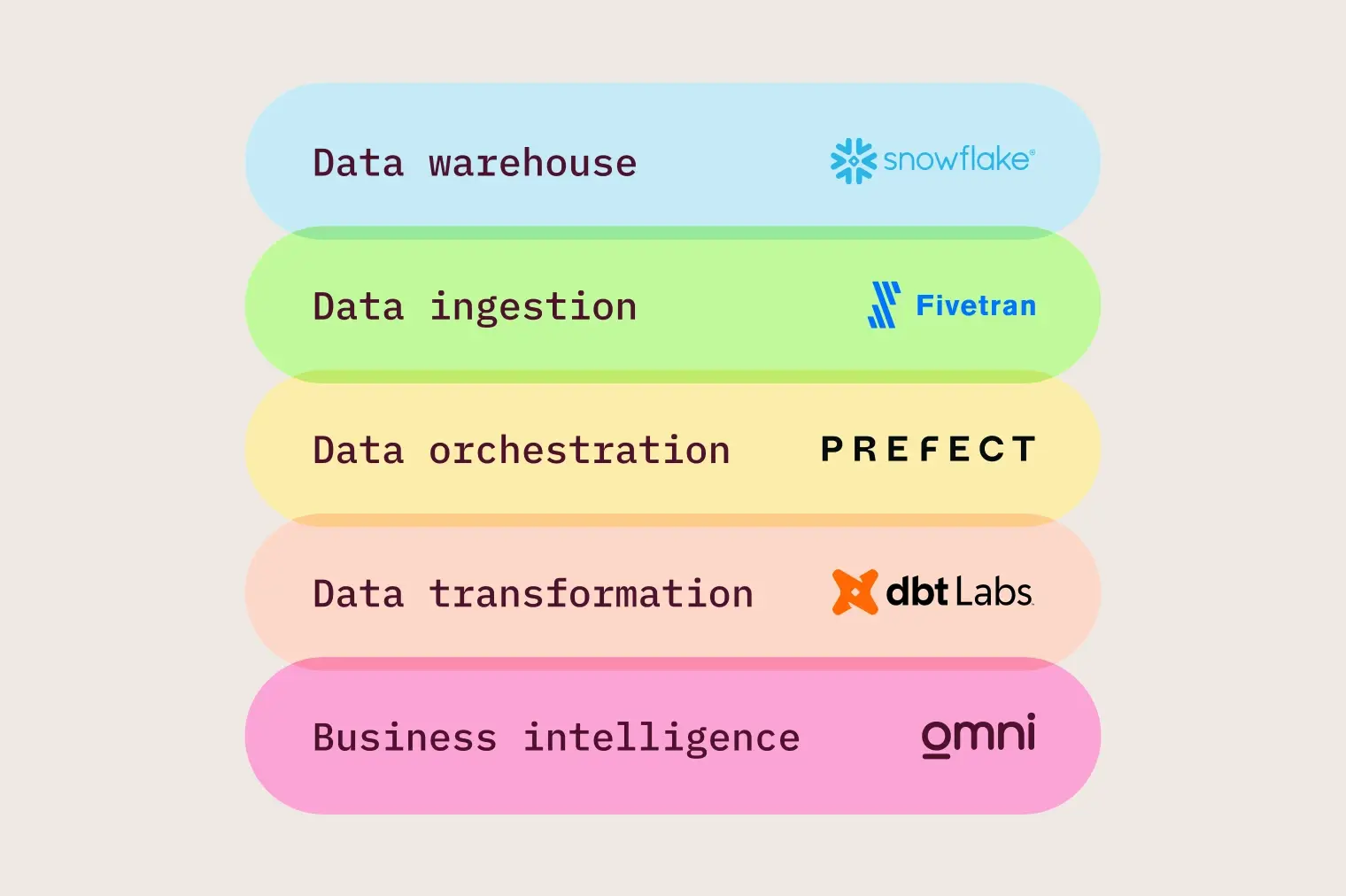
Data Stack #
The challenge #
Data has always been central to Cribl’s culture. From the start, Priya implemented a hub-and-spoke structure to promote self-service. This enabled data-savvy builders across departments to move fast, while keeping guardrails in place to ensure governance.
But their previous BI tool couldn’t keep up with Cribl’s velocity. Product development had slowed, the data exploration experience felt outdated, and the team wanted a faster path to leverage AI. As Priya explained, “Our previous BI tool made people happy, and we had a great deal on our contract. But there was a lot we didn’t have, and I believed we could get more value.”
The evaluation #
Cribl initially evaluated five BI tools, then narrowed its list to two tools for hands-on POCs. When the analytics team scored each option against their top criteria, Omni quickly emerged as the frontrunner for self-service with reliable AI.
“It’s not just about replacing what you already have, but also identifying what you don’t have at all,” shares Priya.
How Omni matched up to Cribl's analytics criteria:
Cribl’s analytics criteria | How Omni matched up |
|---|---|
Faster, easier workflows for builders | Modern UI with version history, built-in Excel calculations, spreadsheets, and AI helpers makes it easier for users to self-serve |
AI & AI admin features | Omni’s AI features allow passing additional context and prompting for smarter responses |
More product momentum | An active, transparent product roadmap with weekly public engineering demos on what’s in development |
Deeper integrations, especially with dbt | Bi-directional dbt integration, Git-based change management, dynamic environment switching, and a UI for model editing |
Securing stakeholder buy-in #
Priya knew replacing a popular tool would require stakeholder support. For the second phase of the POC, they opened up testing to stakeholders across the business.
‘“Even though our analytics team unanimously preferred Omni, we had to make sure the whole company was on board, so we invited users from different departments to test it on their own data,” Priya explains.
Business users quickly tipped the scales toward Omni, with 78 percent saying they would “switch to Omni tomorrow.” Some users even offered to demo Omni’s 1:1 Excel parity themselves.
This transparent process created buy-in at every level. As Priya put it, “We didn’t go into this with rose-colored glasses. We were honest about what we would unlock as well as things we’d have to live with or wait for. This helped us earn trust in the decision.”
The migration #
Once they signed, Cribl migrated to Omni in just three months through a staged rollout process designed to inform and support users.
Here’s how they did it:
Phase 1: The analytics team launched migration communications and shared the timeline to lay out expectations.
Phase 2: Four members of the analytics team went to work migrating ~100 core dashboards in 5 weeks. “Most of our logic lives in dbt. Omni automatically absorbs this metadata, which makes it really easy and fast to rebuild dashboards,” adds Priya.
Phase 3: Key stakeholders and 70+ super users were brought in to validate content, test workflows, and provide feedback before the broader rollout.
Phase 4: One month before turning off their previous BI tool, they made a company-wide announcement to ensure no users were surprised and no essential content was left behind.
Phase 5: Omni was launched GA for the entire company, and access to the old tool was turned off.
“We sent out a survey after the migration, and everyone was really happy — we got a CSAT of 89! One user even reached out to tell us Omni was already saving them 15 hours per month. It’s been awesome to see that validation across the business because we ultimately want to save people time.”
Priya Gupta, Head of Data
The impact #
Using dbt + Omni to surface context to business users #
Like many data teams, dbt serves as Cribl’s single source of truth for metric governance and maintaining consistency.
However, many of Cribl’s BI users don’t sit on the central analytics team or have access to dbt. When they’re analyzing data, they want to understand the logic underlying the metrics they’re using. Omni’s bi-directional dbt integration helps bridge this gap by surfacing valuable dbt metadata directly in the UI, so these power users can see definitions, trace lineage, and understand how metrics are built without requiring access to their data warehouse or GitHub.
“We love dbt because it makes it so easy to apply Cribl’s lens of the business on top of our data; it’s our single source of truth. Omni’s deep integration with dbt allows us to expose more of that context to our stakeholders right where they consume data.”
Priya Gupta, Head of Data
Priya goes on to say that Omni’s dbt integration helps the analytics team move faster, too. She adds, “This also makes the analysts on my team happy because they don’t need to have VS Code and Omni side-by-side as they’re developing the data model.”
Unlocking smarter AI with $20 and context engineering #
As a fast-growing company, documentation had been deprioritized in favor of shipping quickly. However, knowing that documentation and context would improve the accuracy of AI inspired them to reinvest in it. “AI is only as smart as you make it, and Omni gives you a lot of levers to make it smarter. I wanted to make sure we could take full advantage of the platform,” explains Priya.
Cribl launched an automated documentation project to prompt-engineer dbt documentation at scale for their 100+ dbt models. After testing five large language models, they landed on OpenAI and the following process:
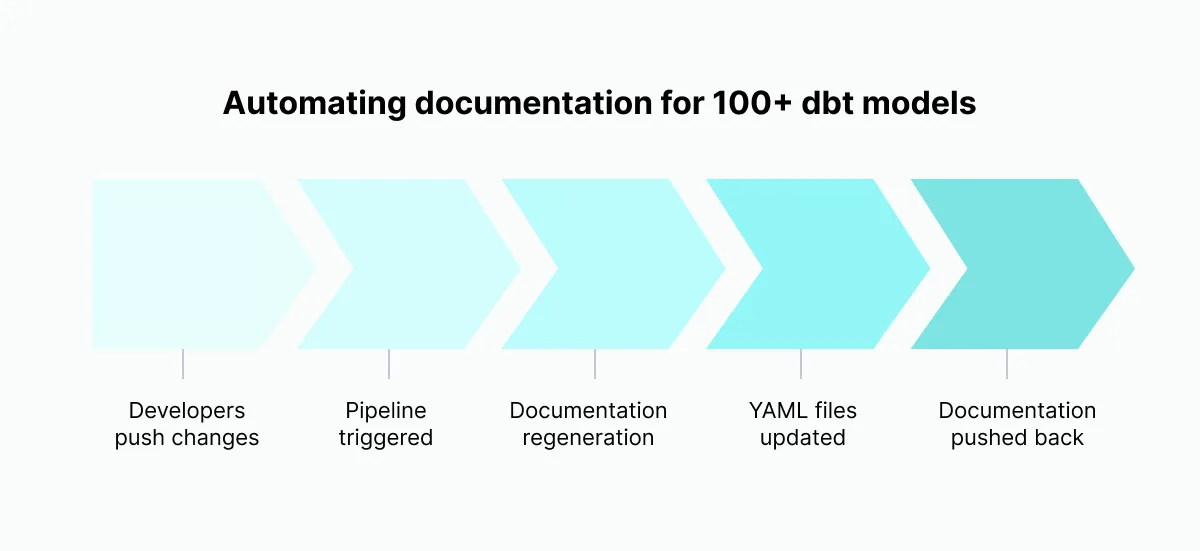
Step 1: Developers open a PR or push changes to a dbt model in an open PR
Step 2: The CI/CD pipeline is automatically triggered upon code push
Step 3: The pipeline regenerates documentation for modified dbt models using the updated code & existing documentation
Step 4: The pipeline updates the corresponding model configuration YAML files with the new column & model descriptions
Step 5: The updated YAML files are pushed to the Git branch & one button refreshes metadata in Omni
Now, the updated documentation provides human-readable lineage and rich AI training data. This created a living documentation lifecycle, ensuring Omni’s AI always has current, trustworthy context. “It’s the best $20 I’ve ever spent,” Priya said. With this, Cribl was able to scale AI access to 700+ with high confidence.
For example, Cribl uses a custom “resolved date” in Jira rather than the default “closed date” to account for tickets that may be reopened. Omni’s AI consistently selects the correct field without users needing to clarify the prompt each time. Priya shares, “Our dbt documentation explains Cribl-specific language, so we used Omni’s automatic dbt metadata sync to train AI with it. Now, Omni’s AI knows when I ask ‘How many tickets did we close?’ to use ‘resolve date’ because it’s pulling from dbt, which is our single source of truth.”
Company-wide AI adoption and learning from usage #
From the start, users praised AI chat and summaries for helping them understand what changed and what to do next. One user who previously had minimal usage quickly became active in Omni, saying, “I’m asking Blobby (Omni’s AI) questions, and it gives me answers so fast!”
“AI allows us to do more with less, but it requires governance and feedback mechanisms to continually improve,” shares Priya. The analytics team analyzes AI usage data to understand what people ask and then improve documentation or fine-tune context.
“Omni’s AI isn’t a black box. We’re able to learn from our own usage and take action. We still have control, and that’s crucial to ensure AI is trustworthy for users across our organization.”
Priya Gupta, Head of Data
To take this a step further, they’re training AI with domain expertise relevant to the user. “For our financial metrics, we added AI context into Omni’s semantic model that trains AI to think like a financial researcher,” explains Priya. “We shape AI’s persona depending on the question being asked, so we can personalize the user experience.” This helps stakeholders get what they need faster and saves the analytics team time.
Accelerating familiar data workflows #
Beyond AI, users across Cribl love using data in familiar ways, like spreadsheets.
“Spreadsheets have been a total game changer for our ARR reporting. It feels like Excel, but it’s fully connected to our live data. We no longer have to download data in order to analyze it how we want to, and we can keep reporting consistent, which has been a huge help to stakeholders.”
Laura Knipe, Staff Data Analyst, Sales & Finance
Users also bring Omni directly into their presentation decks with Rollstack’s integration, which embeds visualizations and dashboards into slide decks to streamline recurring meetings and ensure decks stay aligned to the single source of truth.
As a next step, Cribl is building an internal center of excellence and creating programs to help employees deep dive into Omni. In addition, Cribl also plans to explore use cases with the Omni MCP server to bring insights directly into the workflows of Cribl employees.
Omni has changed the way Cribl thinks about data. By adopting a modern platform for AI and analytics, the data team has shifted from focusing on tickets and dashboards to enabling governed self-service at scale.
“Now, my team is thinking about changing our success metric. We used to measure how many people logged into our BI tool. Now we can measure how many people are using AI and the quality of those responses. As an analytics team, those are things we can manage and control as our company continues to scale.”
Priya Gupta, Head of Data