Every day, sellers and brands around the world rely on Photoroom to turn raw product photos into studio-quality visuals with AI. Processing over 5 billion images a year for customers ranging from independent resellers to global names like Bulgari and Netflix, Photoroom sits at the center of modern online commerce. At over 20 million active users a month, the decisions behind the product need to move just as fast as the product itself.
As the company grew, so did the volume of questions, experiments, and decisions that required fast, reliable data. The lean data team of three was supporting 100+ employees, and their existing BI tool wasn’t designed for the scale or velocity the business needed.
When Juliette Duizabo joined as Head of Data, she focused on one principle: creating alignment so they could unlock AI. “We had a modern data stack, but we didn’t have the shared definitions and governance needed to make AI useful,” she said. Her goal was to democratize data, reduce bottlenecks for analysts, and build a foundation where AI could apply reasoning based on Photoroom’s business logic.
Under Juliette’s leadership, Photoroom migrated to Omni and adopted stricter modeling and documentation practices in dbt. Within a few months, the company changed how every team worked with data.
Results #
Built a single, governed source of truth for both humans and AI: Centralized definitions, metrics, and business rules in dbt and Omni so every dashboard, AI answer, and recommendation follows the same logic, reinforced with color-coded metrics for instant clarity and consistency.
Reduced time to insight from days to seconds across the company: Enabled anyone to ask questions in plain language and get accurate answers in under a minute, including mobile access that returns results in less than 30 seconds.
Embedded data directly into everyday workflows: Extended analytics into Slack and Claude Desktop using Omni’s Slack Agent and MCP server, allowing teams to ask questions, run analysis, and trigger automations without leaving the tools they already use.
Turned analysis into clear, role-specific actions: Delivered AI-generated summaries and recommendations tailored to sales, marketing, and product, helping teams decide what to do next without interpreting raw tables.
Increased leverage of a three-person data team: Shifted routine questions and documentation work to AI-assisted workflows, allowing the data team to focus on durable models, governance, and higher-impact analysis
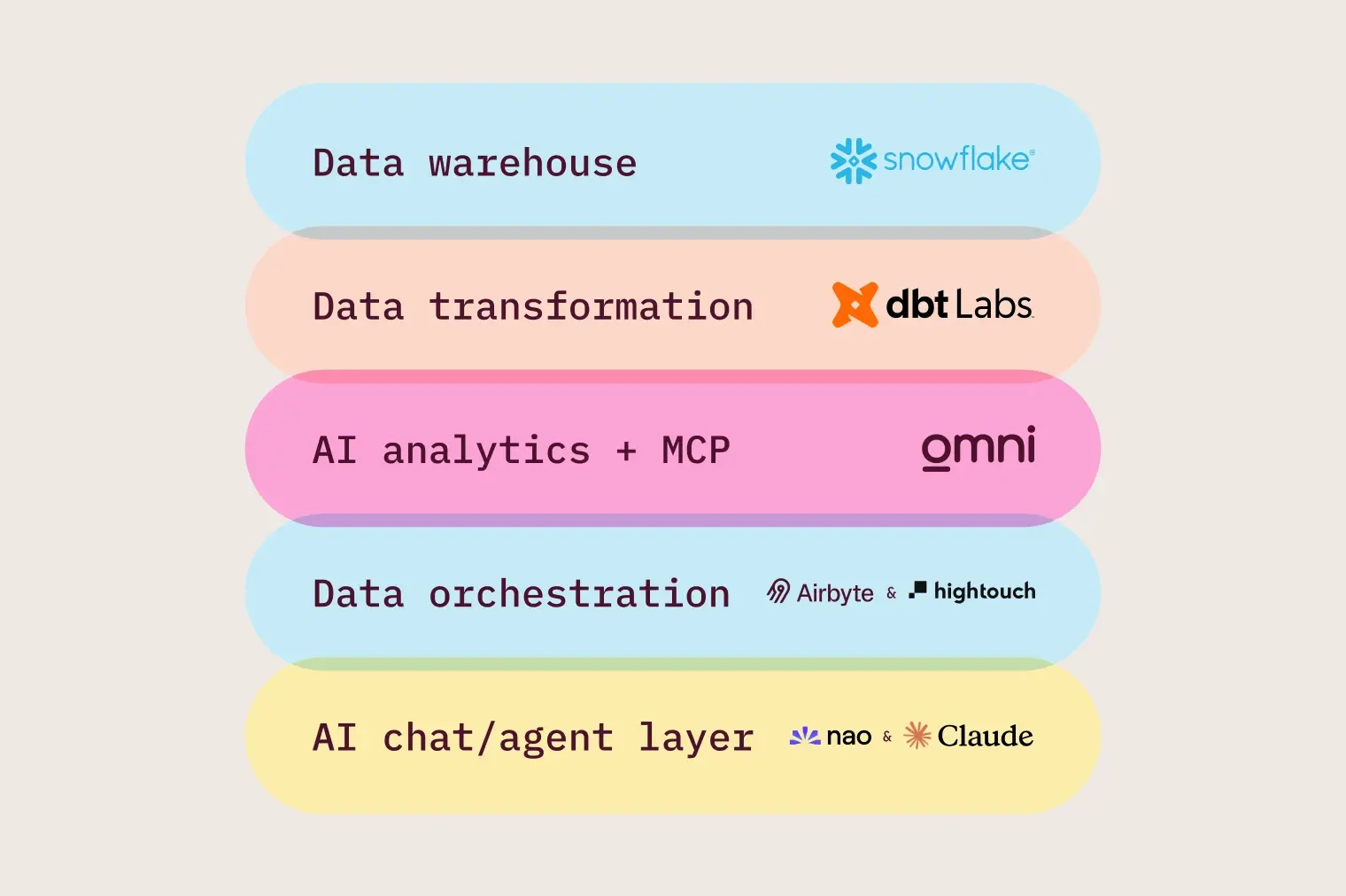
Photoroom’s data stack #
The challenge #
Before Omni, Photoroom had the components of a modern data stack, but they wanted a stronger foundation for self-service and AI-driven exploration. Their previous BI tool centered on dashboards that required technical expertise and ongoing maintenance from the data team. With just three people supporting more than a hundred colleagues, that model quickly became a bottleneck.
Follow-up questions created an especially painful bottleneck. Business users filed a request, waited days for an answer, then discovered a new question that kicked off another multi-day cycle. “Before, answering a follow-up question could take up to five days. With Omni, it takes seconds,” Juliette said.
As part of their goal to improve answer quality and speed, Photoroom wanted to leverage AI. But in a fast-moving culture like theirs, AI would only be as strong as the system behind it.
Photoroom prides itself on shipping quickly — learning, fixing what breaks, writing tests so it doesn’t break again, and moving forward. To introduce AI successfully, they needed shared definitions and intentional guardrails that could keep up with their pace.
As Juliette put it, “we needed AI to reason with our business logic, not improvise around it.”
The migration #
Juliette’s team chose a practical migration path to ensure they built a foundation for shared understanding across their team and for AI. They started with the smallest useful pieces: one dbt model, one view, one Omni Topic. From there, they expanded.
"We wanted quick wins people could immediately put to use,” Juliette explained.
They prioritized the dashboards and questions the business relied on most and rebuilt those first. Everything else was added organically, driven by demand instead of a massive, theoretical migration plan.
To encourage adoption, the data team ran short trainings, created dedicated Slack channels, hosted office hours, and leaned on early internal champions to push new use cases forward. They even created a custom “Blobby medal” emoji inspired by Omni’s AI agent to use when someone did something cool with data.
Once people saw how quickly Omni’s AI agents could answer real questions about comparisons or breakdowns, daily use picked up organically. “The moment someone asked Blobby their first natural language question and got a useful chart and explanation back, they were hooked,” Juliette said.
Building a governed foundation for alignment #
The turning point for Photoroom wasn’t AI itself. It was establishing a governed foundation for humans and AI.
Photoroom built a semantic layer that made definitions, metrics, business rules, and thresholds unambiguous. In dbt, they consolidated every term into a single definitions.md file, enforced it with dbt-datadict, and added an automated check in their deployment pipeline to ensure only one definition exists for each column.
In Omni, the team created clean Topics (curated datasets) and views, moved calculated metrics out of one-off charts into centrally managed templates, and embedded AI context directly into the semantic model so the agent could interpret data the same way the team does.
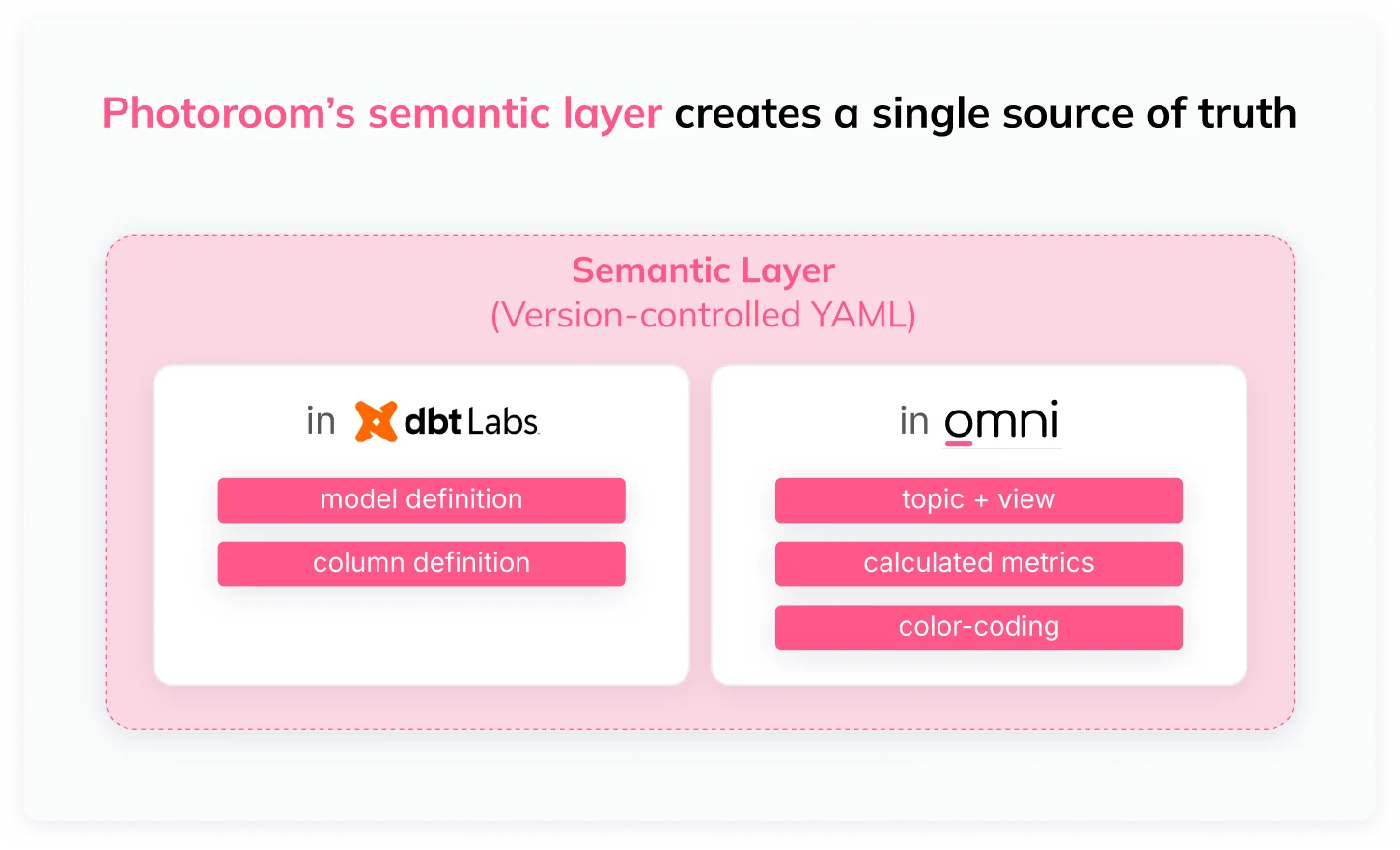
Internally, they treat semantic clarity as an engineering discipline. AI trust, in their view, is not a feature. It is a system built on four pillars: design, protection, validation, and observability.
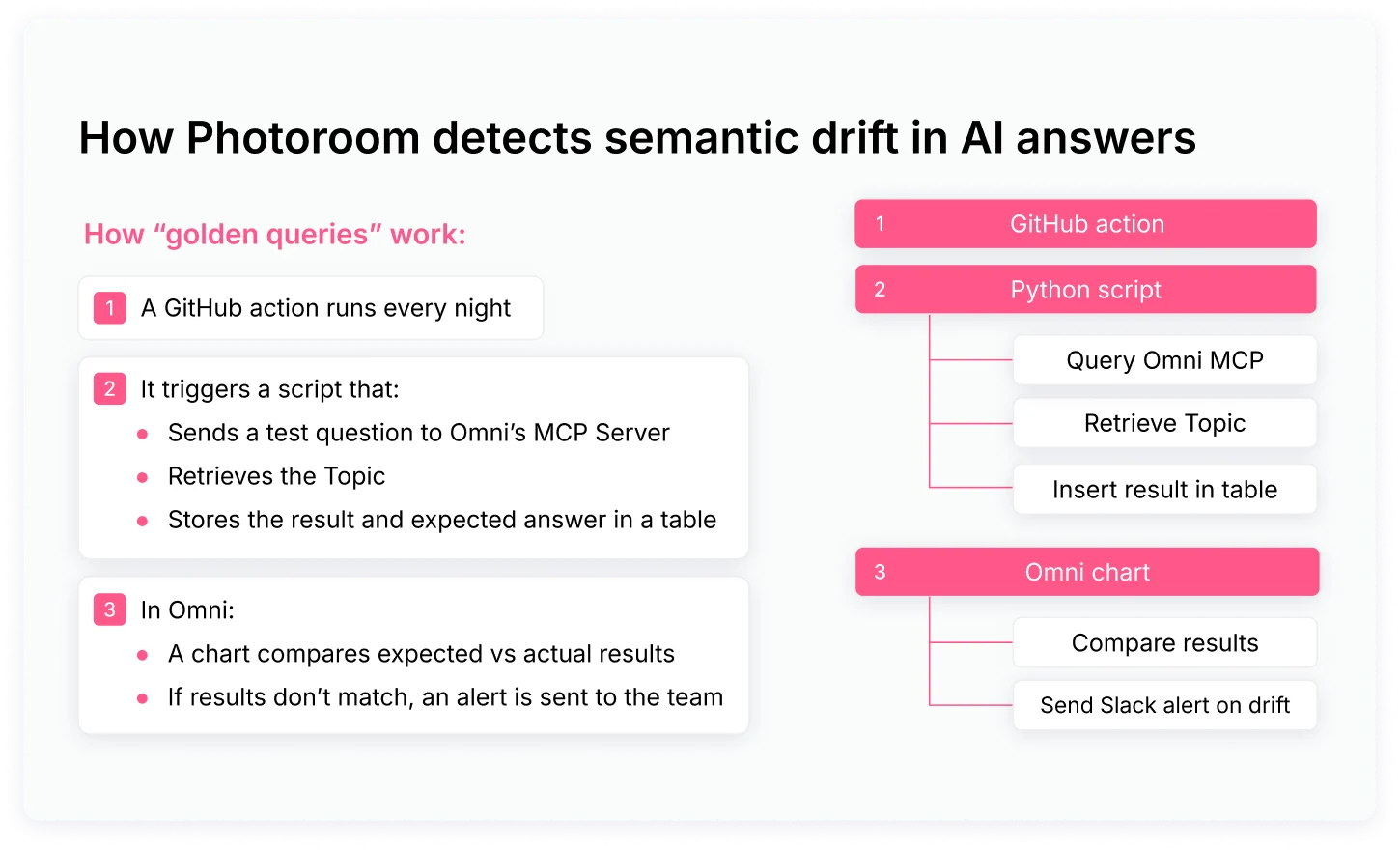
To support that system, the team runs “golden queries” — canonical business questions where the expected interpretation is known. These tests run automatically and alert Slack if the agent selects the wrong Topic or interprets a question incorrectly, which helps them achieve semantic clarity.
Using AI to keep documentation up-to-date #
The same discipline applied to governance now powers their AI workflows. Photoroom uses nao and Omni to generate models and documentation, track metric definitions, and let agents handle the full investigation across tables and models.
“All documentation is written by AI now. It saves us a crazy amount of work.” Juliette explained. “If tomorrow all LLMs were down, it would take me 10 hours to do what I’ve gotten used to doing in 10 minutes.”
This governed, continuously updated foundation is allowing Photoroom to confidently scale AI across the business, with every answer grounded in shared, agreed-upon logic rather than one-off SQL.
The Impact #
Making data accessible everywhere in less than a minute #
Once metrics and business logic were aligned, Juliette’s team focused on scaling data accessibility. They were committed to providing the fastest possible path from question to answer.
“Our goal is for anyone to get a reliable answer in under a minute,” Juliette said.
Today, employees ask questions in natural language in Omni’s chat, such as “Show new users month-on-month”, “Which campaigns underperformed last week?”, and “What’s September ARR for Pro vs Max subscriptions?” Omni’s AI agent chooses the right data, builds the chart, and explains what it means with helpful summaries and key takeaways.
The team extended that experience beyond Omni’s UI using Omni’s Slack agent, enabling employees to query data directly from Slack. A simple command mentioning @Omni returns a summarized answer in the same channel where the conversation is already happening. They’re also using Omni's MCP in Claude and Dust for useful automations, such as drafting emails for users who have completed certain tasks or upsells.
Many employees have also added Omni’s app to their mobile home screen. As Juliette put it, “From the moment you have a question in your mind, if you know how to type on a keyboard, you can have the answer with Omni.”
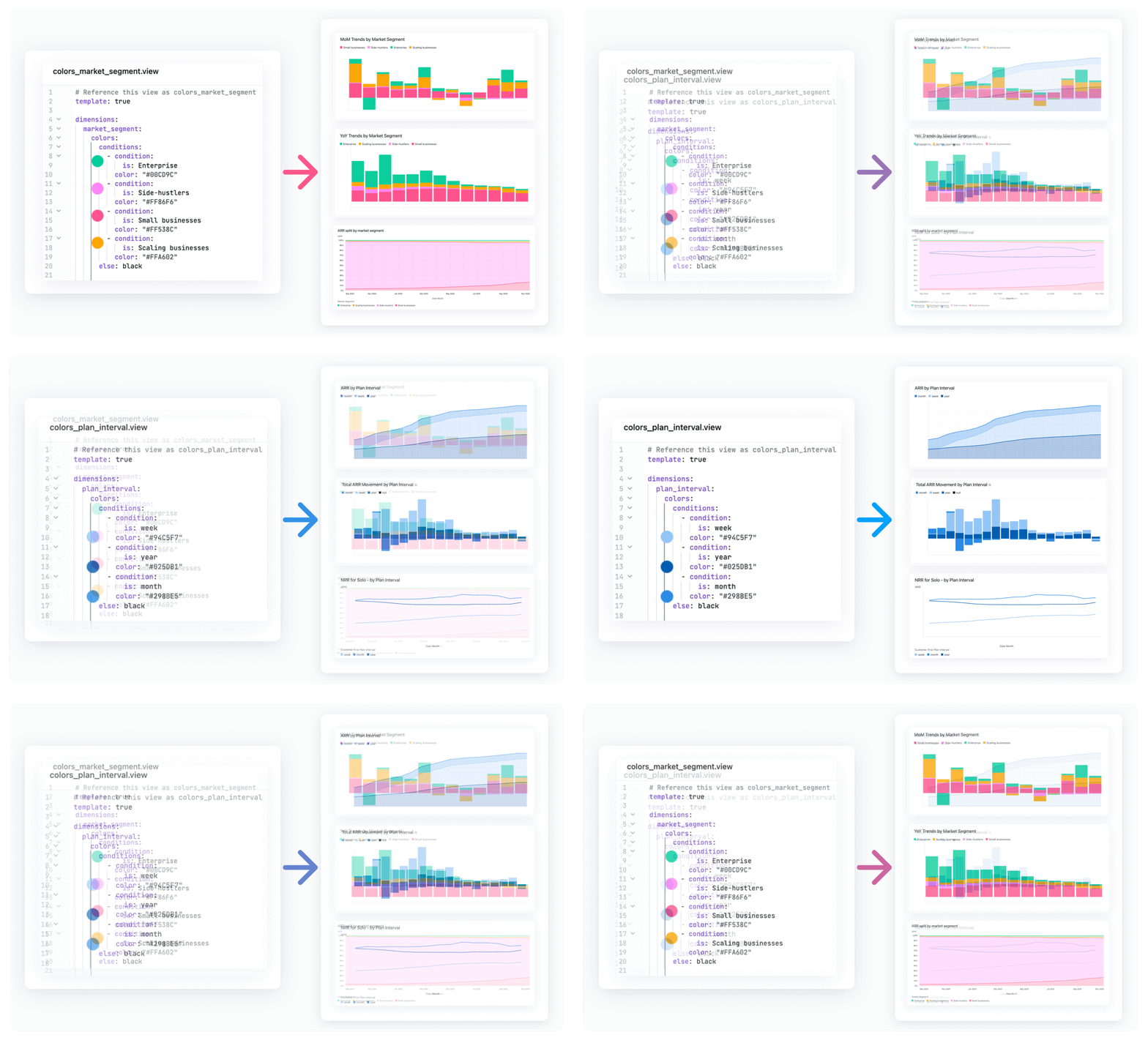
Small design choices reinforced that speed. Photoroom color-coded metrics across dashboards so each category carries a consistent visual signal everywhere it appears. Each metric category has a single assigned color that appears in every chart across the company, creating instant familiarity. Juliette compares it to electrical wiring conventions.
“When you see a color, you already know what the metric represents. It removes friction and keeps everyone aligned,” Juliette said.
Turning insights into action with AI recommendations #
Photoroom’s next goal was to make data not just easier to find, but easier to act on.
They leaned heavily on Omni’s AI summaries. In many cases, having access to data doesn't mean you know what to do with it. Instead of needing to scan dense tables, teams receive concise recommendations that call out which campaigns to keep investing in, which to stop, which accounts show risk, and which performance patterns matter most.
These summaries are powered by small, customizable prompts that experts across the business can tune with their own AI context to help guide responses.
Prioritizing sales activities with AI #
For example, on Mondays account executives (AEs) receive a personalized summary in Slack with their top accounts by activity and risk level, along with recommended next steps generated from Omni and tuned by RevOps experts. “The prompt is strict,” Juliette said with a laugh, “but it works. And our team relies on it.”
Optimizing user acquisition with AI #
The user acquisition team has been exploring a three-agent loop to review ad performance. In this workflow, one agent generates creatives, another posts ads and allocates spend, and Omni analyzes ROAS (Return on Ad Spend) and other performance analytics to recommend the next iteration.
“Omni tells us what is working, then we generate new creatives and invest based on what we observe. This enables our team to test many different creatives in different markets, ” Juliette notes.
Sparking curiosity and creativity across the business #
Photoroom’s AI-first approach has reshaped how the company makes decisions. Because there is no friction, no long wait, and no fear of bothering the data team, people no longer hesitate to ask questions and test new ideas.
And as AI usage grows, Photoroom built a foundation designed to scale. Clear principles, automated CI checks, and nightly monitoring ensure shared definitions, documentation, and lineage stay up-to-date and trusted.
Every team works from the same logic, speaks the same language, and moves faster as a result.
For the data team, this is the ideal outcome. AI handles routine questions, while the team focuses on higher-leverage work. “Instead of doing something once, you build something that is reusable and here to stay,” Juliette said.
“AI only works when the foundation is solid,” she added. “Once you have that, everything becomes faster, clearer, and more aligned. It changes how the whole company consumes data.” *To hear Photoroom's story from Juliette directly, watch her presentation from the Forward Data Conference.