Four years ago, we set out to fix analytics.
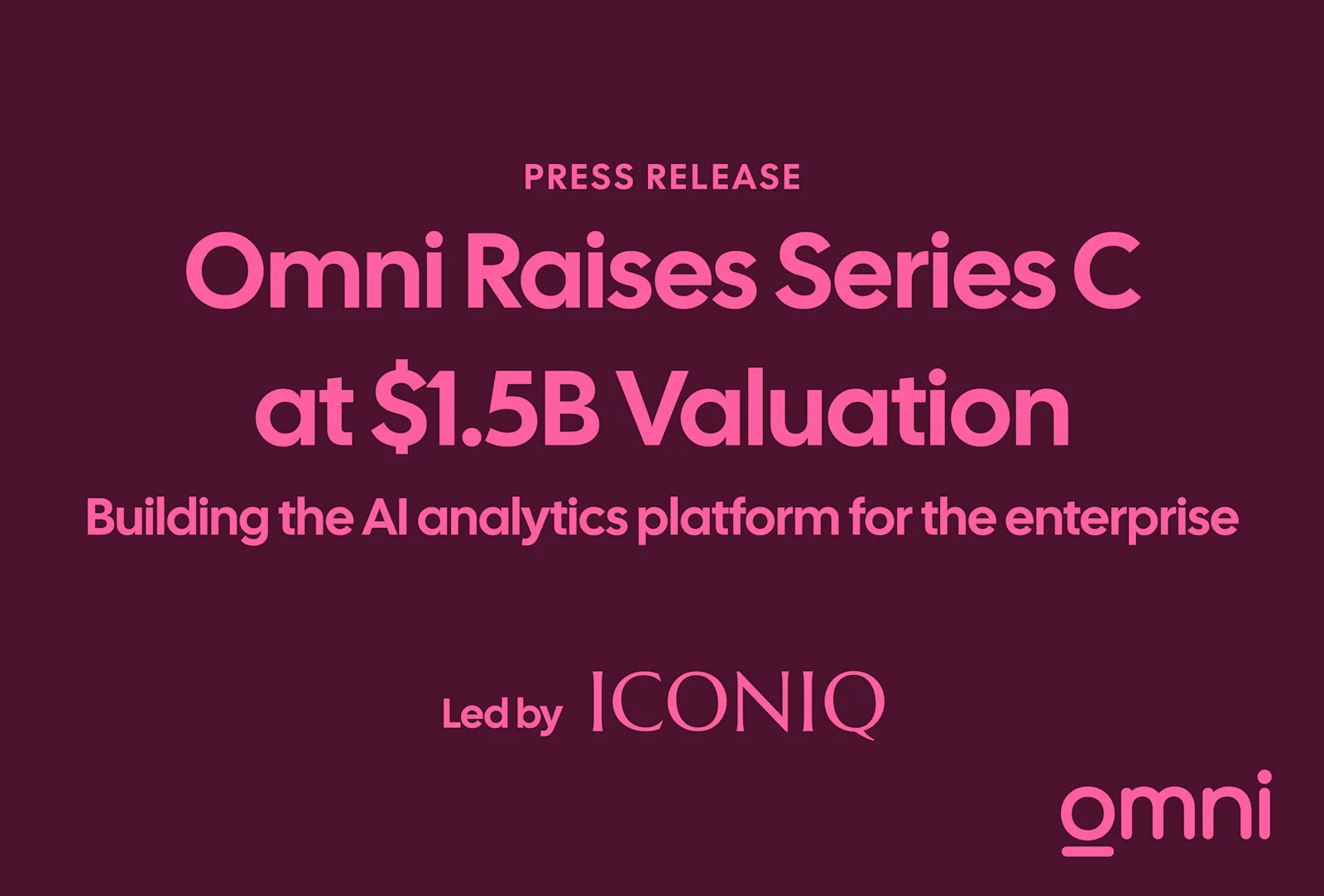
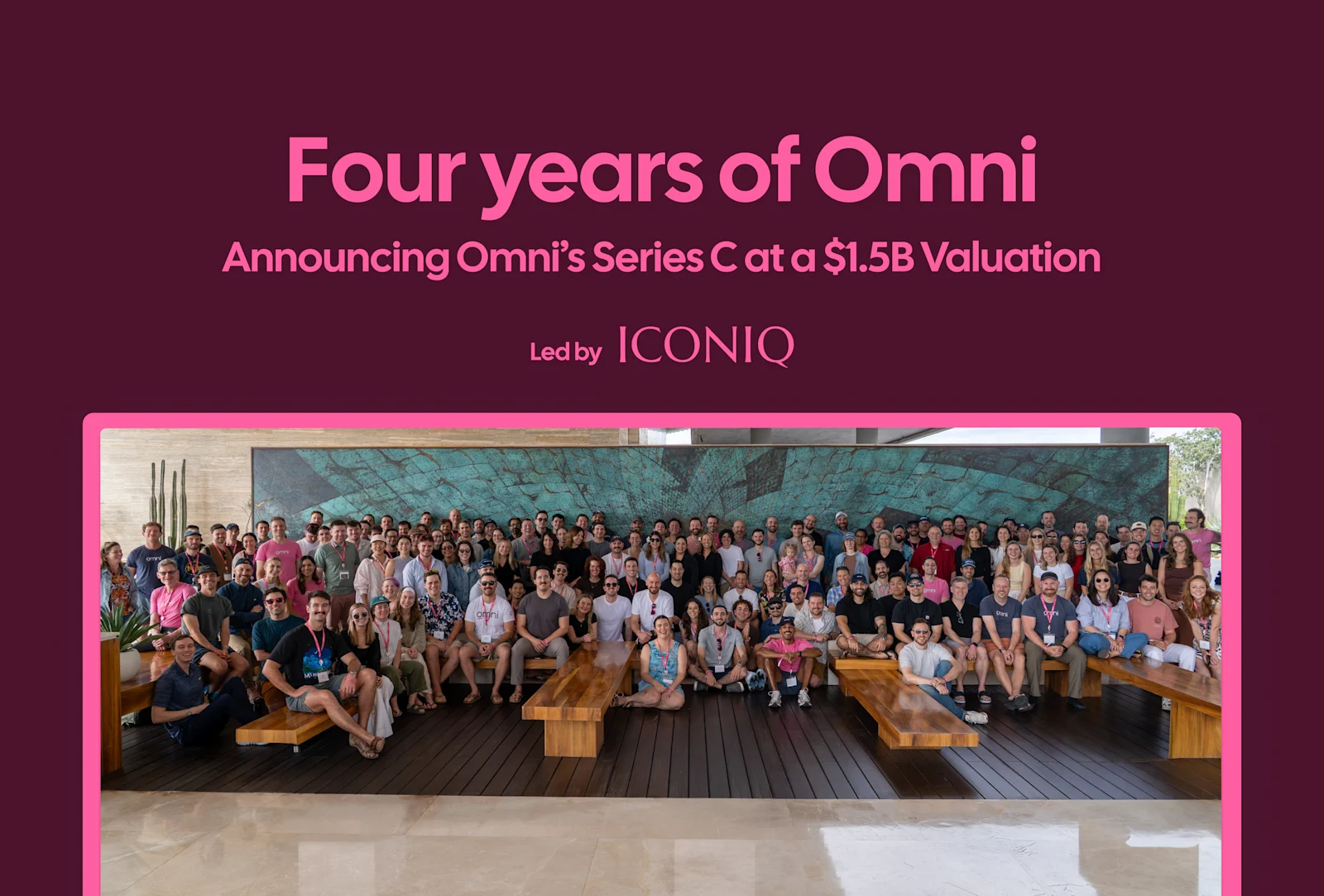
Today, we've raised $120M in our Series C at a $1.5B valuation, led by ICONIQ with participation from existing investors Theory Ventures, First Round Capital, Redpoint Ventures, and GV. As a part of this milestone, we’ve launched an employee tender offer giving our employees liquidity.
We’ve scaled ARR 4x over the last year. This reflects something bigger than Omni. AI is reshaping how people interact with data, and it's happening faster than most companies are ready for.
The foundation is trust #
We started Omni to build a data platform anyone could use and trust. Not just data teams. Anyone who needed an answer. In March 2022, 8 months before ChatGPT's public release, we hadn't yet realized we were building the foundation for an agent native world.
Over the last two years, two things have become obvious.
First, natural language is the best interface we've ever had for data. It's faster than clicking through fields, more flexible than pre-built reports, and far more accessible than code.
Second, it only works at scale with calibrated context. It's tempting to just point an LLM at your database. But AI doesn’t inherently understand your business.
Every company has its own idiosyncratic definition of "revenue," "customer," and even "last quarter." The logic behind these definitions is typically tribal knowledge in people's heads and scattered documentation. Without this specific context, an LLM will confidently guess. Analytics depends on reliability, so guessing doesn't cut it.
This is fundamentally a language issue rather than a modeling one.
What people mean and what the data says are often different. Historically, BI tools forced you to learn the schema and the tool. Now, prompts are the interface, and you can just ask for what you want.
For this to work, this system has to understand what you mean.
What businesses actually need is a platform where they can define all of that context, govern it, and use it as a first-class input to every analytics workflow. That's what we built.
The context layer is the hard part #
Some of the best AI companies are trying to solve this with massive engineering investments. They're building schema metadata, human annotations from domain experts, code-level definitions, RAG across internal systems, and memory at both organizational and personal levels. There's no simple hack or shortcut.
You have to build the data context layer.
We built Omni around a semantic layer because we believed this had to be architectural. One place to define metrics and encode business logic. One system to enforce permissions across every query.
Originally, that foundation earned trust across dashboards, spreadsheets, SQL, and point-and-click workflows.
Today, it powers the AI agents our customers rely on to help thousands of people self-serve answers.
When someone asks, "How did my team do last quarter?" Omni’s AI uses shared definitions from the semantic layer. It runs as the user to respect granular security. It shows its reasoning. And it produces the answer you'd expect from an analyst who understands your business.
What we built for great business intelligence is exactly what AI needs.
Building for intent #
You still need dashboards, spreadsheets, SQL, ad hoc exploration — all of it. These don’t go away. You have to meet people where they are and make sure every foundational piece still gets it right.
The difference is that AI makes you dramatically faster at every single one of them. This isn't about querying data differently; it’s about building every foundational piece to work for the traditional way people are used to working and the new way AI finally lets them work.
Instead of optimizing for clicks and dashboards, you optimize for intent. You think about how questions are phrased, how context is described, and how systems learn from usage over time.
Building for AI means treating context like a living system that gets smarter as people interact with it.
Over the last year, this has shaped everything we do.
We've integrated AI across the entire platform. We have agents that reason through complex questions, run domain-specific tasks, tell you what matters, and help you build your data model. We opened up our platform with APIs and our MCP server. These governed answers don't stop at the edges of our app. Customers embed them into their products and integrate them into tools like Claude, ChatGPT, and Cursor.
The moat #
The moat in AI analytics is the structured context underneath. A shared, reusable understanding of how a business operates.
In Omni, context compounds. Over time, the system gets smarter because it encodes more institutional knowledge.
Our customers are feeding Omni the context they've already built. dbt definitions and documentation, Notion and Google Docs, and meeting note transcripts. The result is AI that consistently selects the right fields, applies correct logic, and speaks the company's language.
I love seeing this happen. People are spending less time on the tedious parts of analytics. They're focusing on encoding their expertise and driving the business forward. That's what analytics is really about.
What comes next #
What analytics looked like six months ago is not what it looks like today. And today's version won't last either.
You still need strong foundations to build great data systems — governance, modeling, and processes to ensure validation. You also need dashboards, spreadsheets, and the workflows people rely on.
But you also need to solve for AI.
The teams winning right now aren't the ones who picked the right tool. They're the ones learning what AI can do, building clear definitions of their business logic, and evolving how they work.
Omni sits in the middle of this shift. The stability of a great foundation and the flexibility to move fast.
I don't think anyone knows exactly what analytics will look like in five years. But we do know how we're going to build for it. We’ll continue to stay close to our customers, learn and adapt, and show our work — sharing our progress for everyone to follow along. That's been true since day one, and it's more true now than ever.
To our customers, partners, investors, and our entire team, thank you.
I can't wait for the next chapter of Omni.
If you’d like to learn how we’re thinking about the future, join me for a live session on May 14th.