The question now comes from the top of the organization. A CFO reviewing a renewal asks it. So does a head of analytics who has already wired a model to the warehouse and watched people use it. It is a fair question, and it got sharper in October 2026, when Anthropic put Claude Dashboards into beta and OpenAI shipped GPT-6 with Intelligent UI within a day of each other.
What makes the question hard is that the obvious test gives a flattering answer. Teams try the model on questions whose answers they already know, then check the output. The model usually passes. That test measures the thing language models are genuinely good at, which is writing SQL, and misses the two things that decide whether a reporting layer can be removed: whether anyone can verify the answer, and whether the person who asked was allowed to see the data behind it.
Checkr ran that test properly before choosing a platform. The team connected an LLM directly to their Snowflake warehouse. In Omni's case study, the finding is blunt: "The same question returned different (incorrect) answers every time." Sarah Fischbach, Staff Analytics Engineer at Checkr, described the specific failure: "For a question that required a join, the LLM didn't even try. It just picked a random field on the same table."
The short answer #
Short answer: No, not as a straight swap. Language models write good SQL, but they cannot enforce per-user row-level permissions, and their wrong answers look exactly like their right ones. Most teams end up running both: chat for exploration, a governed semantic layer underneath so numbers agree and access rules hold.
Key takeaways #
Language models write SQL well. The gap is permissions and verification, not query quality.
Row-level security has no equivalent in a model connected straight to a warehouse.
Text-to-SQL failures are confident wrong numbers. Semantic layer failures are refusals.
Claude Dashboards connects to five warehouses. GPT-6 changes answer format, not data access.
Claude Dashboards has no caching layer, scheduled reports, drill-downs or version control in beta.
Checkr tested an LLM on Snowflake directly and got different answers to the same question.
What is the case for replacing your BI tool with an LLM? #
Short answer: The case is stronger than most vendors admit. Language models answer the long tail of ad-hoc questions faster than a dashboard backlog can, they need no modeling work to start, and they remove a license line from the budget. For a small team with a clean warehouse, that is a reasonable trade.
The strongest version of the argument has four parts, and each one holds.
Most BI usage was never analysis. It was lookup. The "what was revenue last month" class of question is slow in a dashboard and instant in a chat window. A large share of early enterprise LLM traffic is information retrieval rather than analysis, and moving that traffic to chat is a real improvement.
The perceived modeling tax. A semantic layer has to be built and then maintained. Until it exists it answers nothing, while a model pointed at a warehouse answers something on day one. Teams of two with no analytics engineer feel this sharply.
Dashboard sprawl is a real cost. Organizations accumulate variants of the same report until nobody can find the right one, and most of those variants stop being maintained long before anyone deletes them. Chat does not sprawl.
The verification gap is narrowing. Claude Dashboards displays the query behind each number, so a SQL savvy user can check how a figure was produced instead of trusting the chart. That answers the most common objection to LLM-generated analytics, and it deserves credit as such.
Put those together and the conclusion is not naive. It is what a careful CFO would reach from the evidence in front of them.
What about Claude Dashboards and GPT-6 specifically? #
Short answer: Claude Dashboards narrows the verification gap for SQL-literate users and leaves the permissions gap open. Claude Dashboards show the query behind every number, which makes individual answers checkable. Claude Dashboards does not provide per-user row-level access control, so it suits exploration among people cleared to see the same data. The beta also lacks caching, scheduled reports, drill-downs and version control, so each dashboard works as a live visualization rather than a reporting layer.
Anthropic released Claude Dashboards in beta on 8 October 2026, on paid plans. What it does, concretely:
Connects to Snowflake, Databricks, BigQuery, Amazon Redshift, ClickHouse and other apps connected to Claude like Salesforce and MCP.
Builds charts and dashboards from a plain-language question, and keeps them current as the underlying data changes.
Exposes the query behind each displayed number, with the time of the last refresh.
Produces a dashboard as an artifact: an HTML page plus one or more datasets.
Keeps artifacts private to the creator by default, with link sharing where an administrator permits it.
Two of those matter for the replacement question, and they pull in opposite directions.
Query transparency is a genuine improvement. The hardest problem with LLM analytics has been that a wrong answer looks like a right one, and showing the generated query gives a tech-savvy reviewer something to inspect. The improvement stops at SQL-literate reviewers. Claude Dashboards shows the generated SQL unformatted, and some calculations run as JavaScript formulas in the browser rather than in the query, so a non-technical user has no practical way to audit how a number was produced.
Sharing is where the gap stays open. The access model is per-artifact, not per-row. A dashboard is private, or it is shared with people who can see all of it. A reporting layer needs the third option: one dashboard where each viewer sees only their own region, account or team. That is what a semantic layer provides and what artifact sharing does not.
Claude Dashboards also leaves out capabilities that teams expect from a BI tool. As of the October 2026 beta, Claude Dashboards does not offer scheduled reports, downloads, drill-downs, links between dashboards, or advanced filtering such as period-over-period comparison, cross-filtering and dynamic filters. A Claude dashboard is a live visualization of warehouse data, not a reporting workflow.
Claude Dashboards have no caching layer, so every query runs against the warehouse every time a dashboard loads. Edits cost more than they should. A small text change requires the model to rebuild the dashboard, which spends tokens and re-runs every underlying SQL query. On a consumption-priced warehouse, that compute bill grows with every view and every edit.
Claude Dashboards have no point-and-click editing. Changing a chart, or reverting an artifact to an earlier state, means prompting the model to do it, for example by asking it to go back to the previous version, and paying tokens for what a BI tool handles with a click. With no folders, groups or formal version control, artifacts pile up the same way dashboard variants do, so the sprawl that chat was meant to remove comes back as artifact sprawl.
GPT-6 is solving a different problem. OpenAI shipped GPT-6 with Intelligent UI on 7 October 2026, a day before Claude Dashboards. Intelligent UI lets ChatGPT answer with interactive interfaces rather than text alone, including charts, forms and small purpose-built tools generated inside the conversation. The announcement describes no warehouse connectivity. Anthropic moved toward the data. OpenAI moved toward the interface. A team asking whether ChatGPT can replace its BI tool is usually asking about the former, and Intelligent UI does not answer it.
Where does that case break down? #
Short answer: The case breaks on two things, and a demo hides both. A language model querying a warehouse cannot enforce who sees which rows. A language model also produces wrong answers in the same confident register as right ones. Both failures surface after rollout, not during evaluation.
Row-level security has no equivalent #
Permissions are the hard blocker, and the problem is structural rather than a missing feature. A model writing SQL against a warehouse connects with one set of credentials. Whatever that connection can read, every user of the model can read. Filtering afterward means asking the model to police itself, which it does inconsistently. The same holds when the model builds or edits a dashboard: there is no deterministic way to guarantee it applies an access rule every time. And because the connection is shared, relying on the model means giving every user direct access to the warehouse schema.
Row-level security was a founding requirement of the previous generation of analytics tools. Teams discover its absence after rollout, because a demo with one user and full access never surfaces it. The failure is mundane and common: one regional team should see only its own region's numbers, and there is no layer in which to express that rule.
A wrong answer looks exactly like a right one #
A dashboard that breaks shows an error. A model that misreads a join returns a number. Checkr's test is the clearest published example: the same question, asked repeatedly against Snowflake, returned different and incorrect answers each time, and a question needing a join produced a random field from the same table instead.
Where a governed dashboard already exists for a question, instruct the agent to cite it alongside its answer so the user has a verified source to check against. This works. It also requires a governed dashboard layer to point at, which is the thing the swap was meant to remove.
A model has no memory of your business #
Models cannot tell which columns are still in use, which acronym means what, or which of four date fields the business reports on. Fischbach's framing is the clearest version: asking a question of AI without context is like hiring a brilliant analyst who shows up with no memory of the business, so someone re-explains the metrics, tables and acronyms on every question.
That re-explanation is the work. Doing it once, in a place every query reads from, is what a semantic layer is. Doing it per prompt is what teams find they are doing instead.
What does the evidence actually show? #
Short answer: Grounding a model in a semantic layer improves accuracy measurably, and the size of the gain depends heavily on how well the underlying data is modeled. The honest caveat is that the best-known benchmark was run by a company that sells a semantic layer.
dbt Labs published a paired benchmark on 7 April 2026 using the ACME Insurance dataset created by Juan Sequeda and colleagues at data.world, running 11 questions 20 times each. On the modeled version of the project, after the authors added three dbt models, claude-sonnet-4-6 moved from 90.0% accuracy with text-to-SQL to 98.2% through the semantic layer, and gpt-5.3-codex moved from 84.1% to 100.0%.
The condition matters more than the headline. On the original unmodeled schema, both models scored 64.5% with text-to-SQL and 72.7% through the semantic layer. The semantic layer still wins, by a far narrower margin. What produced the large gap was the modeling work, not the retrieval method on its own. That is the actual finding, and it cuts both ways: a semantic layer is only as good as the modeling underneath it.
Two further caveats belong here. dbt's authors note that the text-to-SQL runs loaded the full schema as context, which is not practical on larger datasets, so those text-to-SQL numbers may be optimistic. And text-to-SQL scores are already high in absolute terms, which is exactly why the swap looks attractive in a demo. The remaining error rate is the whole problem. A tool that is right nine times in ten, with no way to tell which time is the tenth, is not a reporting system.
When is going direct to the LLM the right call? #
Short answer: Going direct is right when nobody needs to be restricted from anything, when questions are exploratory rather than reported, and when a wrong answer costs little. That describes more teams than BI vendors like to admit, and pretending otherwise is why most vendor content on this question is not trusted.
Going direct makes sense when:
Everyone who can query should see all the data, so permissions are moot.
The output feeds a human judgment, not a committed number or an external report.
The team is small enough that inconsistent definitions get caught in conversation.
You have no semantic layer yet and need answers this quarter.
The work is genuinely exploratory, where a notebook or raw SQL would otherwise be the tool.
Going direct breaks down when:
Different users must see different rows of the same table.
Numbers leave the building, in board packs, filings or customer-facing reports.
More than a handful of people ask the same question and need the same answer.
You cannot afford a confidently wrong number.
There is a real cost on the other side, and it should be said plainly. A semantic layer answers well inside what has been modeled and poorly outside it. Ask a question the model does not cover and a well-built system either refuses or falls back to raw SQL, reintroducing the inconsistency it was meant to prevent. The maintenance is ongoing too. As Fischbach puts it: "Giving AI context isn't a one-time project; it's a loop and a part of the job now." Governed semantics buy reliability at the cost of coverage and upkeep, and teams that model slowly feel both.
So what should you do? #
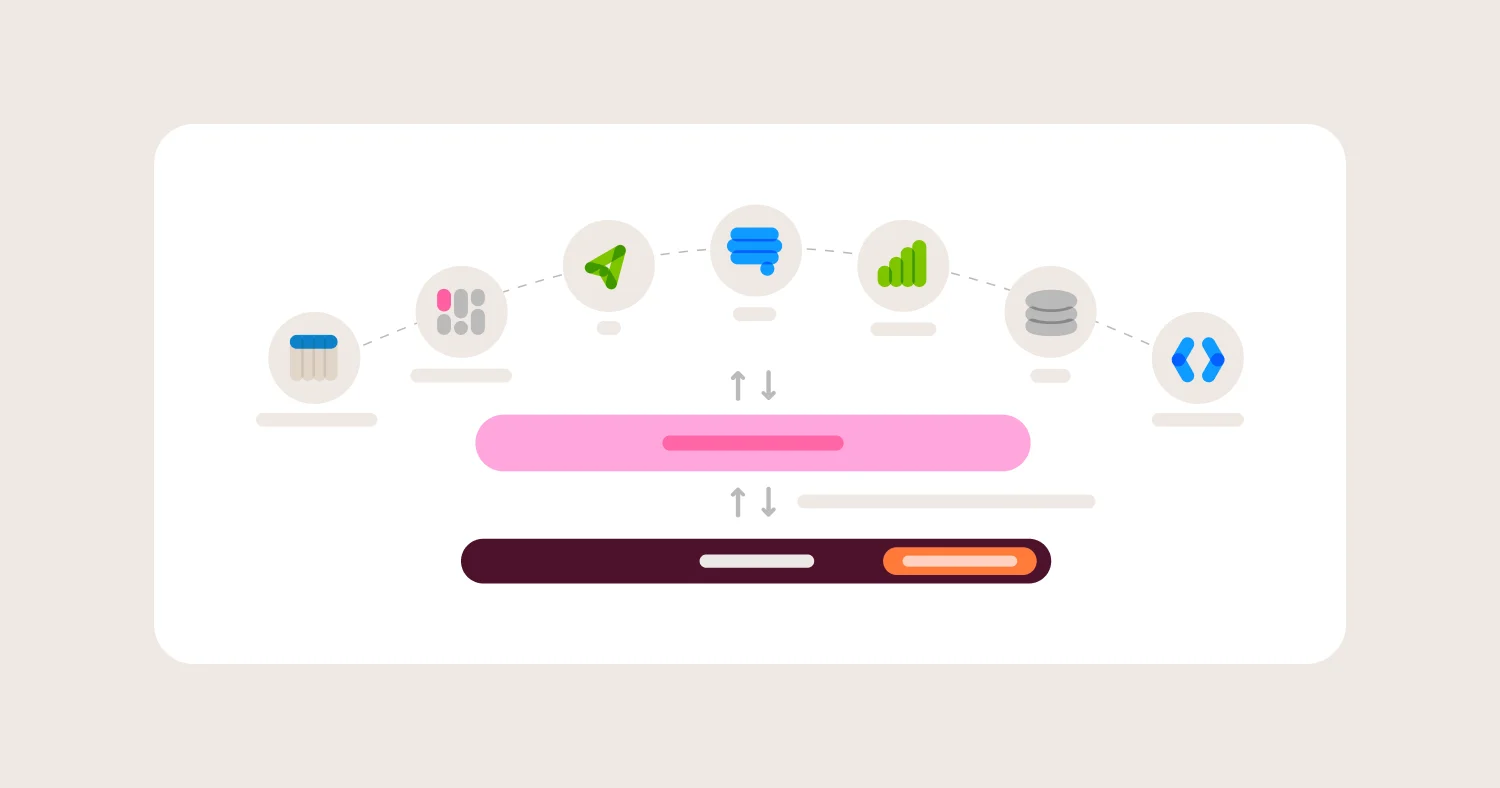
Short answer: Stop evaluating this as a replacement decision and evaluate it as an architecture decision. The question is not whether chat beats dashboards. The question is where definitions and permissions live, and whether both interfaces read from the same place.
Go direct to the LLM if:
Your whole analytics audience can see all the data.
Your questions are exploratory and the answers are not reported.
You have no semantic layer and need to move this quarter.
Keep a governed layer underneath the chat if:
Any user must be restricted to a subset of rows.
The same metric is used by more than one team.
Numbers go to a board, a regulator or a customer.
You need to show where an answer came from.
Run both, which is where most teams land, if:
You want chat for the long tail and dashboards for the recurring set.
You need AI answers and committed reporting to agree.
The practical test is one question: when someone disagrees with a number, what do you point at? If the answer is a chat transcript, you do not yet have a reporting system. If it is a definition that both the dashboard and the chat interface read from, the interface stops mattering, which is the actual goal.
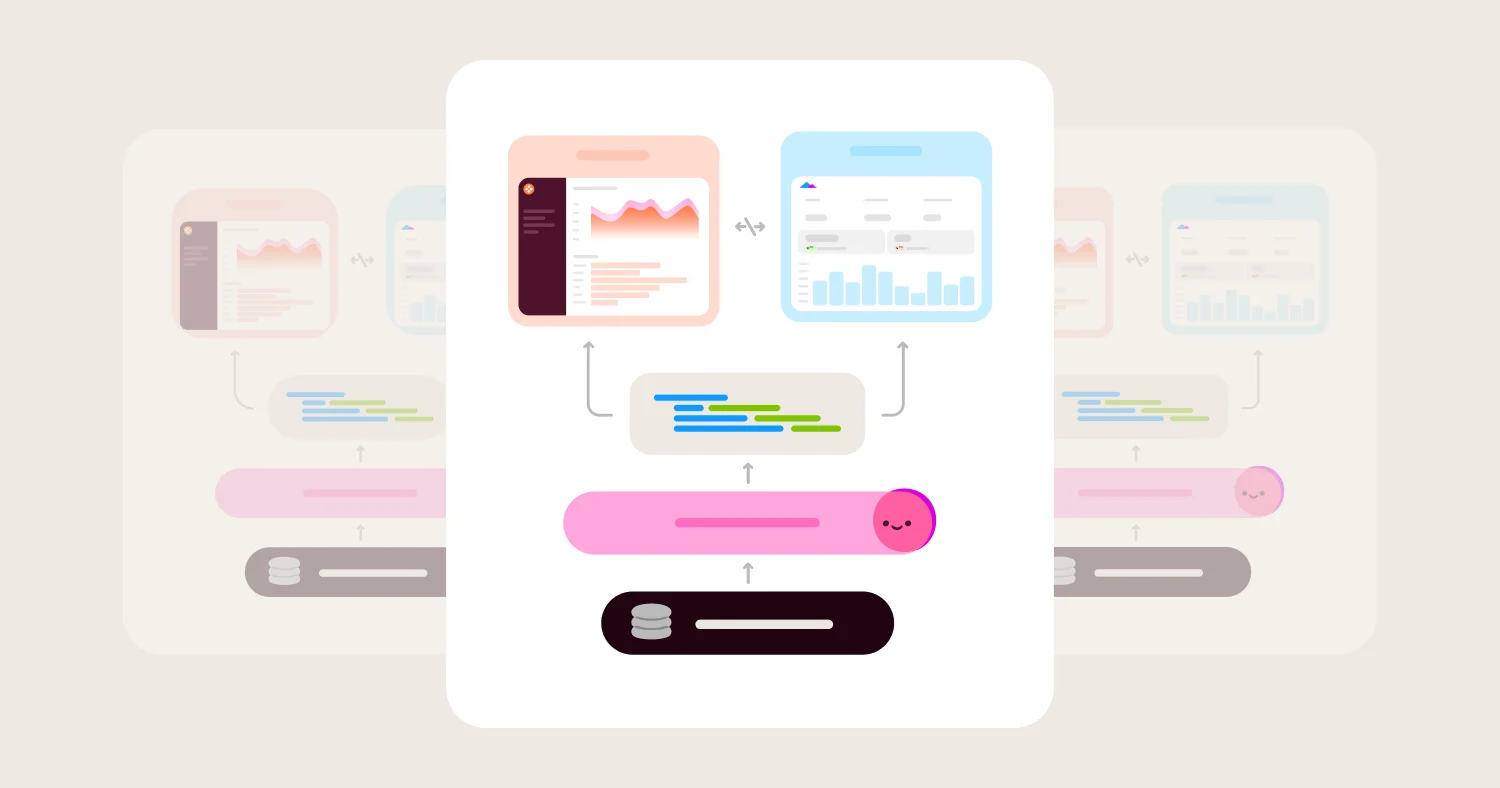
This is the problem Omni is built around. Omni's AI generates semantic queries rather than raw SQL, so a question asked in chat resolves through the same modeled definitions and the same row-level permissions as the equivalent dashboard. Access rules follow the user into every surface, agents included. Fischbach's description of why that matters is better than ours: "The semantic layer is deterministic and precise; it defines what calculations exist."
A Claude dashboard that proves useful does not have to be rebuilt by hand. Omni can import a Claude Dashboards export as an Omni app, mapping each query onto the semantic model so the same definitions and access rules apply.
FAQ #
Can ChatGPT replace a BI tool? #
Not as a direct replacement for governed reporting. ChatGPT writes competent SQL against a warehouse, but it cannot enforce row-level permissions and gives no way to verify which answers are correct. Teams typically keep a semantic layer underneath and use chat as one interface onto it.
Can Claude Dashboards replace my BI tool? #
Claude Dashboards, in beta since October 2026, connects to major warehouses and builds live dashboards from plain-language questions, and it shows the query behind each number so answers can be checked. Claude Dashboards does not provide per-user row-level permissions, so it suits exploration among users cleared to see the same data rather than governed reporting across teams.
What is Claude Dashboards missing compared to a BI tool? #
As of its October 2026 beta, Claude Dashboards lacks per-user row-level permissions, a caching layer, scheduled reports, downloads, drill-downs, cross-filtering, period-over-period filters, folders and formal version control. Edits and reverts happen by prompting the model, which spends tokens and re-runs the underlying warehouse queries.
Does GPT-6's Intelligent UI make ChatGPT a BI tool? #
No. Intelligent UI, launched with GPT-6 in October 2026, lets ChatGPT respond with interactive interfaces including charts and small generated tools, which changes how an answer looks rather than where the data comes from. The GPT-6 announcement describes no data warehouse connectivity.
Why can't an AI agent enforce row-level security? #
An agent querying a warehouse inherits the permissions of the connection it uses, not of the person asking. Enforcing per-user access means filtering inside a layer the agent cannot bypass. Omni applies that filter in the semantic layer, so the same restriction holds in chat, dashboards and embedded views.
What is the difference between text-to-SQL and text-to-semantics? #
Text-to-SQL asks a model to write a query against raw tables, so business logic is re-derived on every prompt. Text-to-semantics asks the model to query predefined metrics and joins, so the logic is fixed and the same question returns the same answer.
Why do we get different answers when different people ask the same question? #
Because each prompt re-derives the definition. Without shared metric definitions, a model picks a defensible interpretation of "revenue" or "active user" each time, and those interpretations differ. A semantic layer fixes the definition so every interface resolves it identically.
Do I still need dashboards if I have conversational analytics? #
Most teams keep both. A dashboard carries more information in one view than a back-and-forth conversation, which is why recurring reporting stays there. Chat handles the long tail of one-off questions that would otherwise become a dashboard request.
Can I move a Claude dashboard into a governed BI tool? #
Yes, in Omni. Omni's Claude dashboard import rebuilds a Claude Dashboards export as an Omni app on top of a connected model. SQL queries are mapped onto the model's definitions. Styles and uploaded files are not carried over, and each import creates a new app.
What should we test in a proof-of-concept? #
Test the two things a demo hides. Give two users different access rights and confirm each sees only their own rows. Then ask the same business question five different ways and check whether the answers match. Query quality will pass. These two usually do not.
Methodology #
Customer evidence in this article comes from published, attributable sources. Checkr's test of an LLM against its Snowflake warehouse, and Sarah Fischbach's quotes, are published in Omni's Checkr case study. Benchmark figures are cited to dbt Labs' April 2026 paired benchmark, with the modeling condition and the authors' own caveat stated, and noted as published by a company that sells a semantic layer. Claude Dashboards and GPT-6 capabilities are described as of their October 2026 releases and verified on 21 October 2026.
The goal was not to argue that BI tools are indispensable. Where going direct to a model is the right call, this article says so.