me&u is a mobile order-and-pay platform serving 7,000 venues across Australia, New Zealand, the United States, and the United Kingdom. With more than 28 million guest profiles and one million orders each week, the company generates data across millions of customer interactions.
After me&u merged with Mr Yum in 2023, Director of Data & Analytics Tom Imbert wanted to simplify the company’s analytics environment and make data easier to use across the combined business.
Within a year of launching Omni, analytics usage roughly doubled and AI-driven queries grew more than 30x as employees accessed the same governed data through Omni’s AI, user-built spreadsheets and dashboards, and Claude via MCP. With more teams building for themselves, the data team now spends less time on ad hoc reporting and more time improving the models, context, and governance behind self-service.
“The whole point of Omni is that whatever entry point people are most comfortable with, whether it’s a workbook, Blobby [Omni’s AI agent], or Claude, it’s the same governed model underneath. Same joins, definitions, and access controls.”
— Tom Imbert, Director of Data & Analytics
Results #
Launched Omni in two months
me&u moved from contract signing to launch in roughly eight weeks. Working with Shearwater Data, an Omni implementation partner, the team established modeling best practices and a framework for its regionalized Snowflake environment.
Doubled analytics usage, with AI-driven queries growing 30x+
Within a year, Tom estimates analytics usage roughly doubled. AI-driven queries against me&u’s Omni model grew more than 30x as employees began using Claude via MCP.
Increased self-service report building across product and finance
The number of PMs building and publishing their own reports increased +90%, with product teams publishing 150+ dashboards and completing 5,000+ analyses in the first year. Finance started moving some important reporting out of Excel and into Omni and created me&u’s most-viewed dashboard.
Cut routine reporting work for the analytics team
Tom says time spent building reports has “collapsed.” The team now spends more time improving data models, AI context, integrations, and governance.
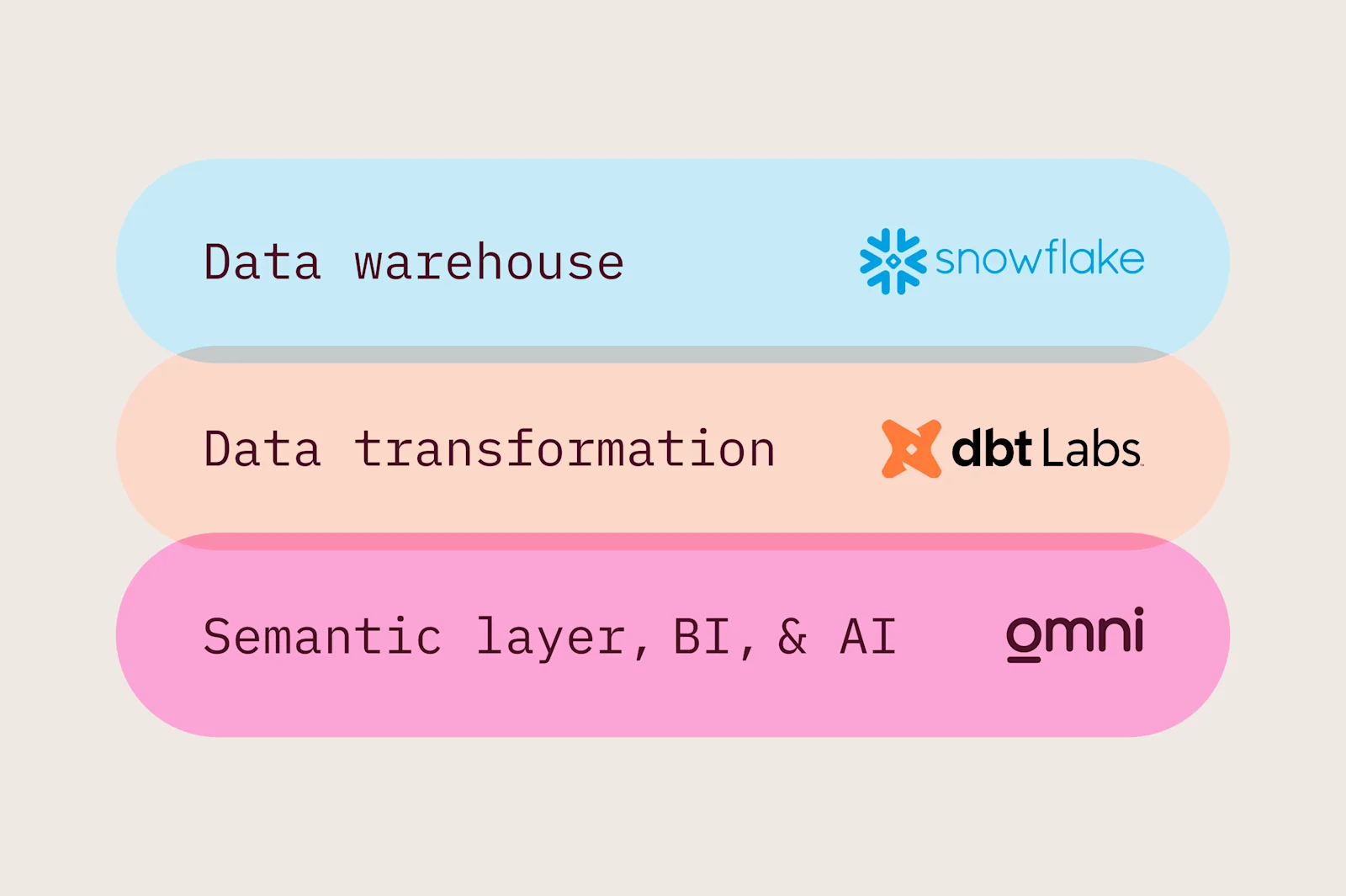
me&u's data stack #
The challenge #
In 2023, me&u merged with former competitor, Mr Yum. Bringing the two businesses together left the data team with a lot to untangle.
“That merger meant that we had two of absolutely everything on day one. Two ordering platforms, data stacks, sets of pipelines, two warehouses’ worth of models and two definitions of revenue. And somehow, we had four separate BI tools. It was a lot to make sense of.”
— Tom Imbert, Director of Data & Analytics
Both companies had taken different approaches to their data infrastructure. While they had four BI tools, Sisense Fusion was the most broadly used, but it created friction for both data and business teams. Business users faced a relatively high barrier to self-service, while Tom’s team struggled with more advanced workflows such as data modeling and version control.
They set out to find a platform that integrated closely with Snowflake and dbt, supported stronger governance and modeling practices, and made self-service easier across me&u.
The evaluation #
me&u evaluated roughly 15 BI platforms before narrowing the field to Omni, Sigma, and Lightdash, with Sisense serving as a baseline. The final decision included direct testing of specific use cases and feedback from teams across the business.
For Tom, the evaluation became less about first impressions and more about which platform could support the combined company over time. The merger had brought together people with different levels of technical experience, so me&u needed one BI platform that could serve that range of users while giving the data team the structure and control to scale. The semantic layer became central to that decision.
“I could see the power of Omni. It was clean. The Topic-based modeling made a lot of sense, and having modeling as code through YAML was a big deciding factor for me.”
— Tom Imbert, Director of Data & Analytics
Omni’s modeling philosophy fit closely with how Tom’s team already worked. It queried Snowflake directly, mirrored dbt, and provided a shared semantic model with consistent joins, definitions, and access controls. The model could also live as YAML in Git, so changes could be reviewed, versioned, and reverted using the team’s existing development workflow.
AI was initially a secondary consideration.
“Over the course of the assessment, it became very hard to ignore AI, and I'm glad we realised that. We didn't necessarily choose Omni for AI, but we got it anyway. And it's ended up changing how every part of the company touches data.”
Once me&u selected Omni, the team went from signing the contract to launching in roughly two months.
“We were on an accelerated timeline, so we partnered with Shearwater Data. They guided us with best practices on how to build for our specific use cases, such as handling regionalized Snowflake instances and building robust Omni Topics.”
Analytics usage doubles as self-service expands #
Within a year of launching Omni, Tom estimated analytics usage had roughly doubled as more teams began answering questions and building analyses themselves.
Leadership just asks
Executives began using Blobby, Omni’s AI Agent, to answer questions directly. In one example, me&u’s CPO used natural language to explore venue reviews, ratings, and sentiment, then identify patterns around busy venues.
“People at the executive level are now getting the answers themselves very quickly. Rather than sidelining an analyst for two hours, it’s five minutes, and they have what they need,” Tom says.
Go-to-market discovers faster with AI
The same behavior spread across go-to-market teams. Account managers, sales, onboarding, and support use Omni for revenue lookups, target tracking, churn, and CRM analysis. Even when the answer already exists in a dashboard, simply asking a question can be faster.
“Our account managers know the reports exist, but for some questions, it’s just quicker to ask. They can get to the same verified answers without having to look for the right report first.”
— Tom Imbert, Director of Data & Analytics
Product & Finance started building
Product and finance have gone further by building for themselves. The number of product managers publishing their own reports increased +90%, with product teams publishing more than 150 dashboards and completing over 5,000 analyses in the first year.
Finance has also started moving some important reporting out of Excel and into Omni spreadsheets and created me&u’s most-viewed dashboard.
MCP usage passes in-app queries
me&u later rolled out Claude across the company and connected it to Omni through MCP, giving employees another way to work with the same governed data.
“We did the work to make Omni as accessible as possible through MCP, and now Claude can query our Omni model directly. People really took to it. It's now roughly an 80-20 split, with most people using Omni through Claude. This is because Claude also has everything else they've connected, such as their docs, tickets, and other internal tools and skills. Our AI queries have grown by more than 30x, because everyone can just ask for what they need.”
More people across me&u can now answer their own questions from the platforms and workflows they already use, reducing reliance on the data team for every request.
The impact: Faster answers & more interesting work
As self-service grew, time spent on report building “collapsed,” giving the data team more capacity to focus on the models, context, and infrastructure behind me&u’s analytics.
One recent request showed the change. A question came into me&u’s data-request Slack channel that Tom estimates would previously have taken someone half a day to answer. He passed it to Claude, which queried Omni, created two workbooks, wrote a summary, and posted the response back to Slack.
“It was perfect.” Tom laughed.
With fewer ad hoc requests to handle, the biggest change is how the data team spends its time. One analytics engineer is taking more ownership of Omni and its connections to Claude and Snowflake, while the rest of the team can improve data models and the context that helps users get accurate answers.
What’s next: governance at scale #
As more people across me&u create their own analyses, the company continues to invest in the models and context behind those answers. Its largest Omni model now includes more than 50 Topics and over 100 files of AI context, which are designed to capture business-specific knowledge.
“A lot of the context is the unglamorous stuff that’s very specific to our business: Money is stored in cents, a trading day runs from 5 a.m. to 5 a.m., and our orders come from two legacy platforms, so the model needs to know which is which. Getting those details right is what helps people trust the answers they get.”
me&u pairs that work with prompt-engineering training across the company, beginning with product and engineering before expanding to the wider business. Tom says most employees are now prompting effectively and, combined with the context built into Omni, complaints about answer quality are becoming rarer.
As adoption grows, Tom’s team is turning more attention to governance. Demand for validation has grown as employees build and analyze faster, helping the team identify where additional context, clearer guidance, or stronger controls could improve the experience.
“We’re thinking about how to put more guardrails around which sources and Topics people should use, when something should be blocked, and which sources should take priority.”
With the foundations in place, me&u’s next focus is scaling that access responsibly across the business.
For Tom, the work supports a broader change in how people at me&u approach data. “AI has broken the usual paradigm of, ‘I’ve got to build something. Who do I talk to? Do I have to learn something?’ It brings it back to the core questions people want to ask about the business, so they can just start exploring and taking action.”
— Tom Imbert, Director of Data & Analytics