Otrium is a fashion marketplace where brands list end-of-season stock and shoppers browse curated collections. Bad data means wrong stock, wasted margin, and clothes that never get worn — which contradicts the company's sustainability mission.
The analytics team runs lean with just two senior data analysts, Wouter Nijdam and Liubov Zevaeva. Until recently, a big chunk of their week went to answering Slack requests.
"In the past, we tried the classic approach of expecting users to build the reports by themselves," Liubov says. "The problem is that self-serve in traditional BI tools is not knowledge; it's a skill. It's like going to the gym. You need to do it regularly. For our users, that time investment beyond their core jobs doesn't make sense."
Then Otrium migrated to Omni, and it changed how the entire company works with data. Now everyone can easily query and build with AI on top of their governed semantic model. The data team saves time previously spent on ad hoc requests, and stakeholders make faster decisions.
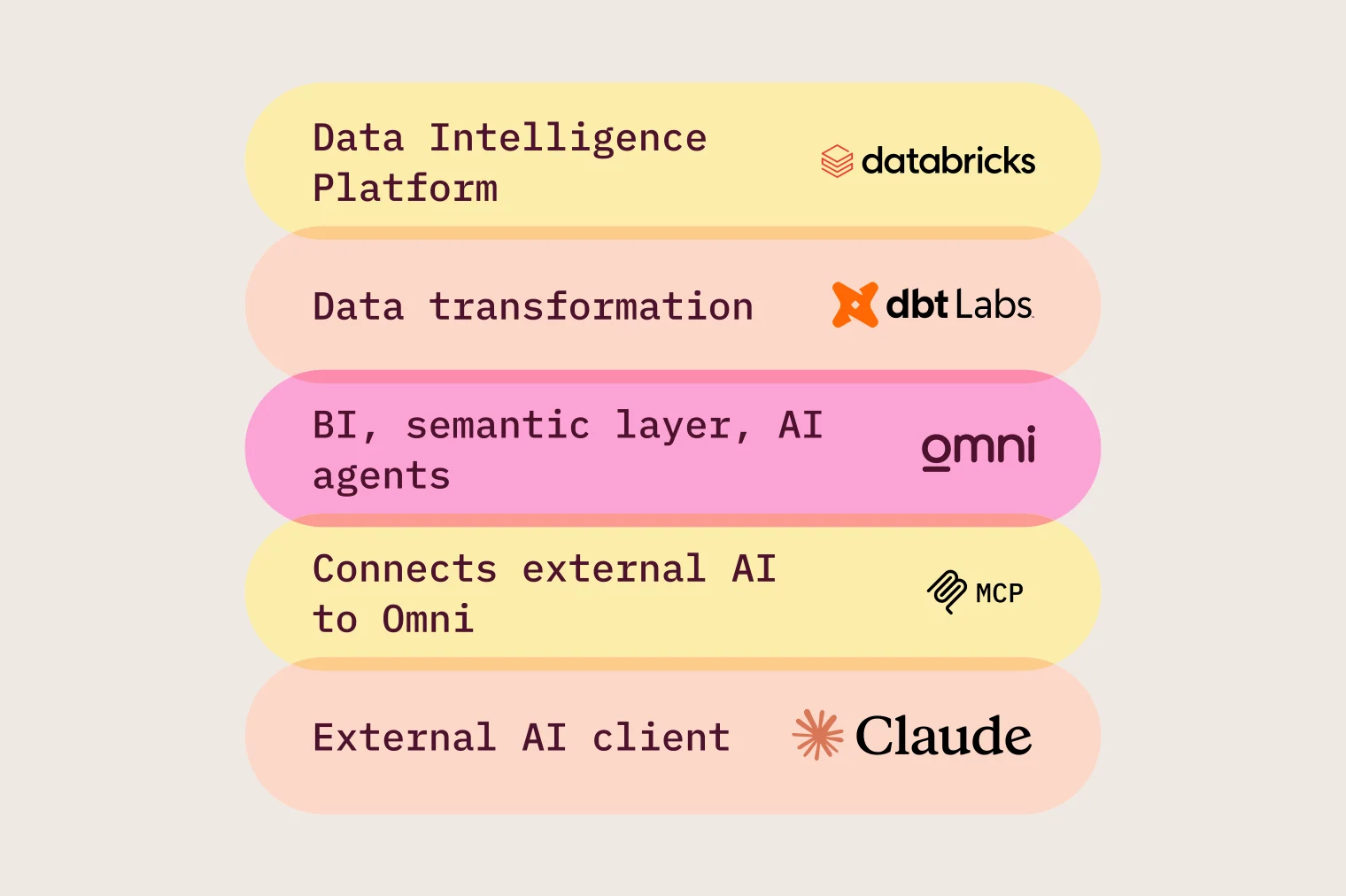
Otrium's data stack #
Results #
Time savings across teams: The data team eliminated ad hoc 'pull me this data' requests, which previously made up 30% of all requests, saving business stakeholders ~5 hours/week per person with faster access to insights.
AI adoption increased alongside data maturity: Two-thirds of users rely on AI across chat, dashboards, and Claude to understand what happened and how to move the business forward. This helps everyone from merchandising and brand to finance and supply make faster decisions.
Retention answered without the queue: One product director used Omni's MCP server to analyze retention from his phone, identifying what was driving softer repeat purchases in specific customer groups and leading to new acquisition and engagement tactics.
Faster merchandising decisions: The time required for merchandising to analyze brands, categories, and markets for flash sales was reduced from a few days to just 15 minutes.
Before: The data help desk challenge #
Ask anyone at Otrium how they got data a year ago and you'd hear the same three options: find a dashboard, build a report yourself in the BI tool, or post in #support on Slack.
Unsurprisingly, almost everyone picked Slack.
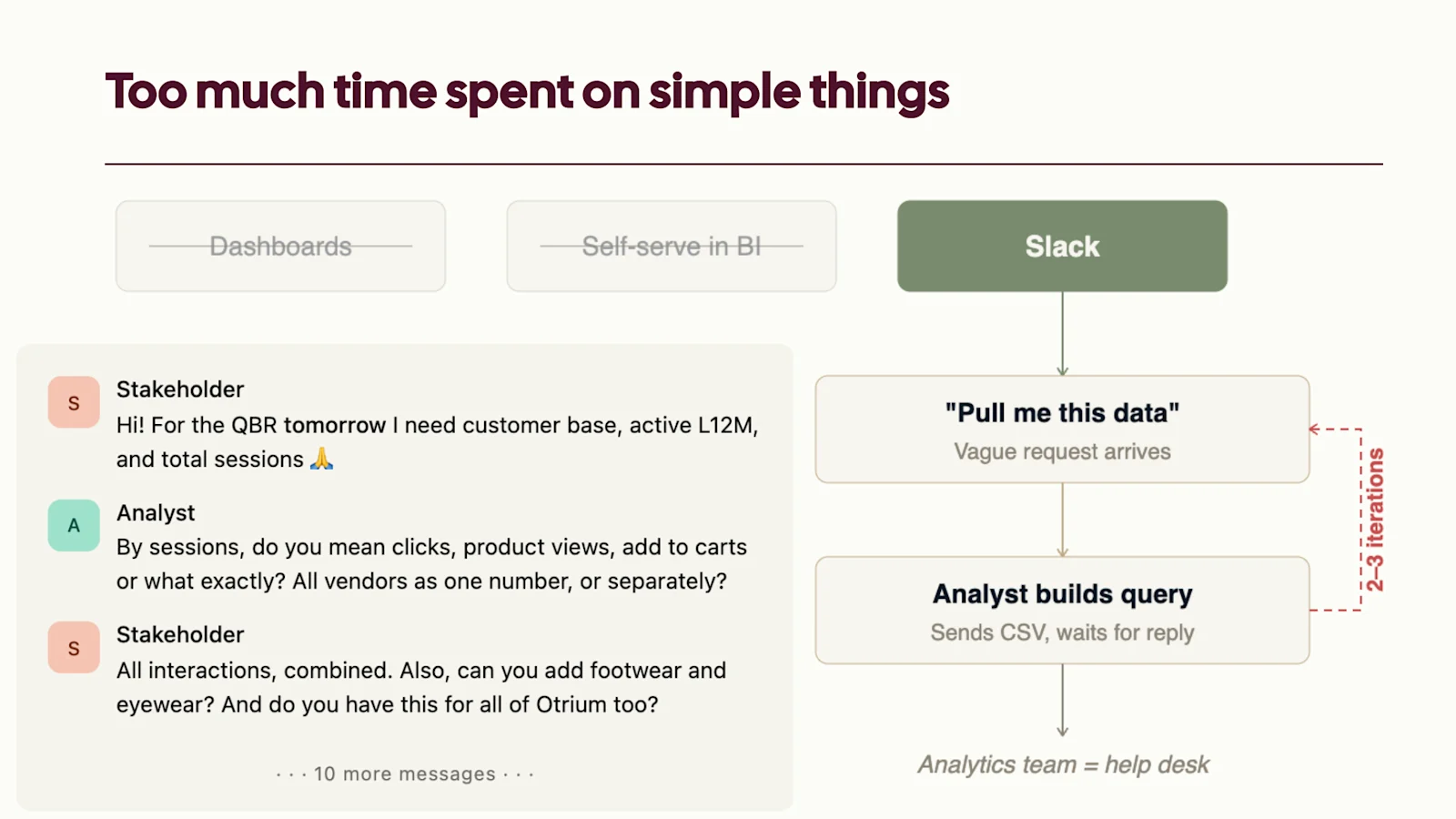
Wouter and Liubov didn't blame anyone for it. "If you're a brand manager and you need to make the decision by the end of the day, you don't have the time to build reports or verify if the data is correct," Wouter says. "You would rather go to an expert and just get the data."
Since most requests required two or three rounds of clarification, answers could take days. Liubov shares, "Our lean analytics team became a part-time help desk. That's not fun for us, because ad hoc is the most boring part of the data job. And it's not great for our users, because they were waiting for the answer quite a lot of the time."
They wanted to teach people how to fish for themselves, but no one had time to build up their BI muscles. So instead, they set out to make AI do the fishing.
Laying the foundation for reliable AI #
After evaluating several BI tools and selecting Omni, the team set out to build a foundation for long-term success.
"We've taken a very pragmatic approach. We start with the basics, and then focus on what people commonly ask for," Wouter says. "If a question comes up several times a week, it goes into BI, and that's just it."
Here's their process:
Clean up data to eliminate duplicate metrics and clarify confusing ones, such as those including VAT or with returns
Rename metrics to be readable by humans and AI, with rich context and descriptions on how to use each metric
Build Topics in Omni's model as curated data sets with definitions, joins, and permissions, so AI answers are faster and scoped to what each user can access
Sync dbt docs to Omni through the dbt integration, so a definition written once in dbt is the same in Omni
Proactively test and verify answers to common questions to learn where the model can be fine-tuned (a process the team now does even faster by using Omni's AI Hub)
Whether stakeholders ask questions in the built-in Omni agent, Claude over MCP, ChatGPT, or Slack, ongoing tests give the team confidence in results. Omni lets them run those tests, so they find opportunities to improve before their users find errors.
If I ask the same question to different agents, will they give me the same answer? That's quite important, because otherwise different people in the org are going to have different opinions about things.
Wouter Nijdam, Senior Data Analyst, Otrium
When asked for her biggest piece of advice for other teams, Liubov didn't hesitate:
"Cleanup resolves everything. Analysts may know how to navigate messy data and incomplete descriptions, but you're no longer just building for analysts. If you're giving messy data to users and to AI, then you need to expect a lot of strange answers based on incomplete information."
Results: Cutting ad hoc requests and returning 5 hours a week to every employee #
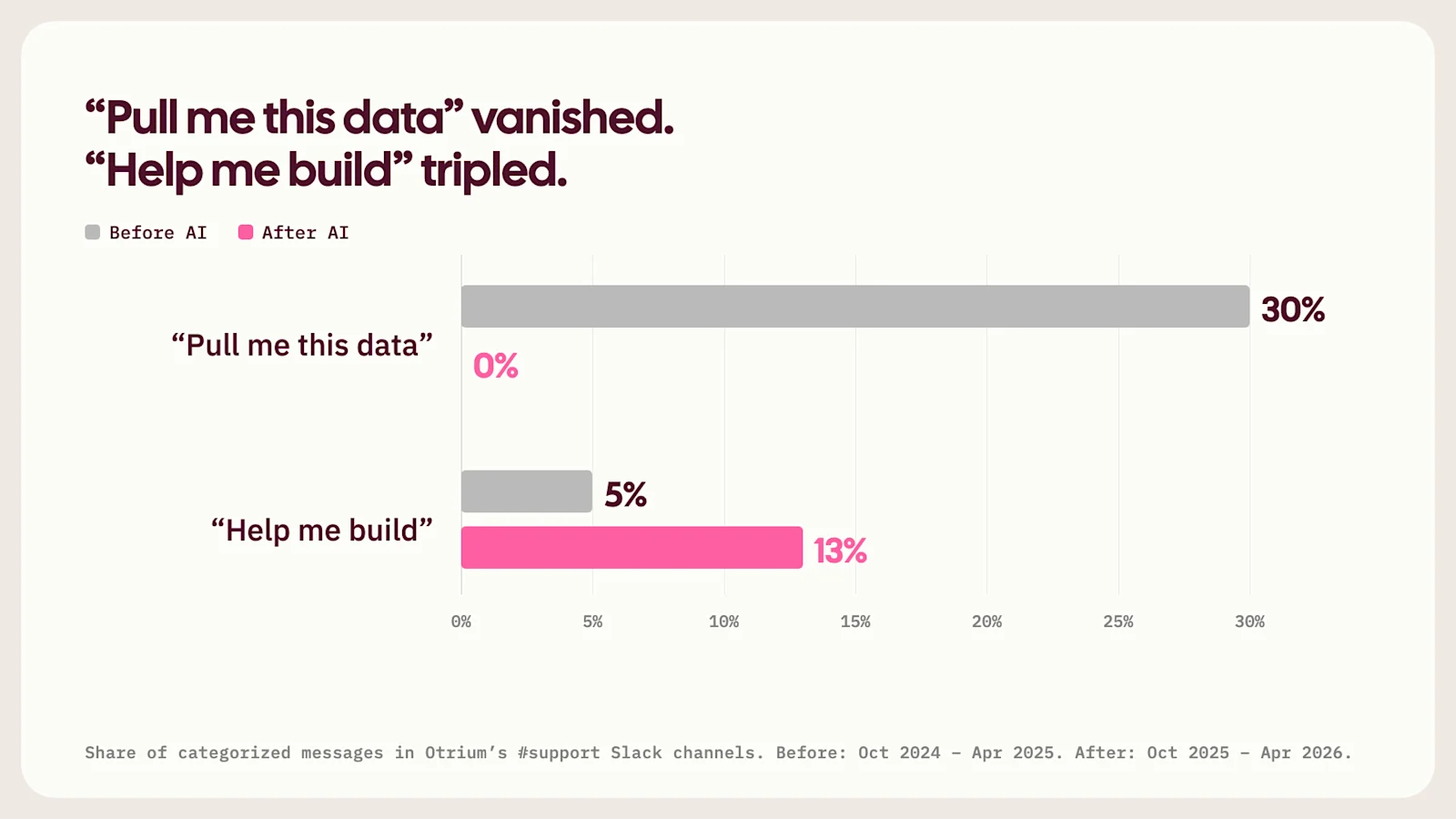
To measure the impact, the team looked at their data support channel messages six months prior to the AI rollout and six months after, and then they categorized every message.
Before AI, 30% of the requests were to pull data for a basic understanding of what happened. After AI, the "pull me this data" category vanished.
"Now everybody is transitioning from asking 'what' to asking 'why' and 'how,'" Wouter says. "They want to understand why things are happening and what they can do to improve their part of the business. It's a much better, more interesting conversation to have."
It's not just saving the data team time. Everyone who uses Omni is saving an average of 44 minutes per day, or ~5 hours per week, when looking at current usage and time previously spent waiting for typical requests.
Liubov believes that even greater gains can't be measured because time previously spent waiting is now spent analyzing and acting.
Solving retention from the couch with Omni's MCP server #
AI is changing how everyone at Otrium works, including leadership.
Rob Myers, Otrium's Director of Product, Tech & Data, explains: "The chat interface encourages deeper curiosity. It's not just a one-and-done. It invites follow-up."
This curiosity led Rob to tackle a challenge from his phone that previously would have required weeks of analytics work. "My very clickbait headline is that I managed to do a pretty heavy-duty piece of retention analysis from my sofa in half-term."
The retention question
As Otrium continued to acquire new customers, retention was down in certain areas and customer groups, and the leadership team wanted to understand why.
The couch query
One Saturday evening over the half-term holiday, Rob was curious, so he opened Claude on his phone after the kids were in bed. He used Omni's MCP server to access the same governed semantic model curated by the data team. "It's very easy just to sit there on the sofa while your other half is watching Bridgerton."
Within 30 seconds, he started getting somewhere.
Retention was down in certain areas and customer groups, with no seasonal recovery. His analysis also uncovered a gap in the model: no one had built 90-day first-order retention. So, Rob built it from his phone. He started by letting Claude read the skills the team created about how Otrium breaks down its metrics.
It was a helpful start to know for certain that something was moving in the wrong direction, but then my immediate question was 'why?' With AI, it's really easy to just ask and find out how far you can get, so I shot for the moon, and it built the retention model for me.
Rob Myers, Director of Product, Tech & Data, Otrium
The model trained by looking at browsing behavior for 270,000 customers. During the session, Rob uncovered that 40% of new customers were "ghost customers," who buy one or two items and never come back. Their retention was only 11%, versus nearly 3x that for customers who browsed 20+ products on their first visit.
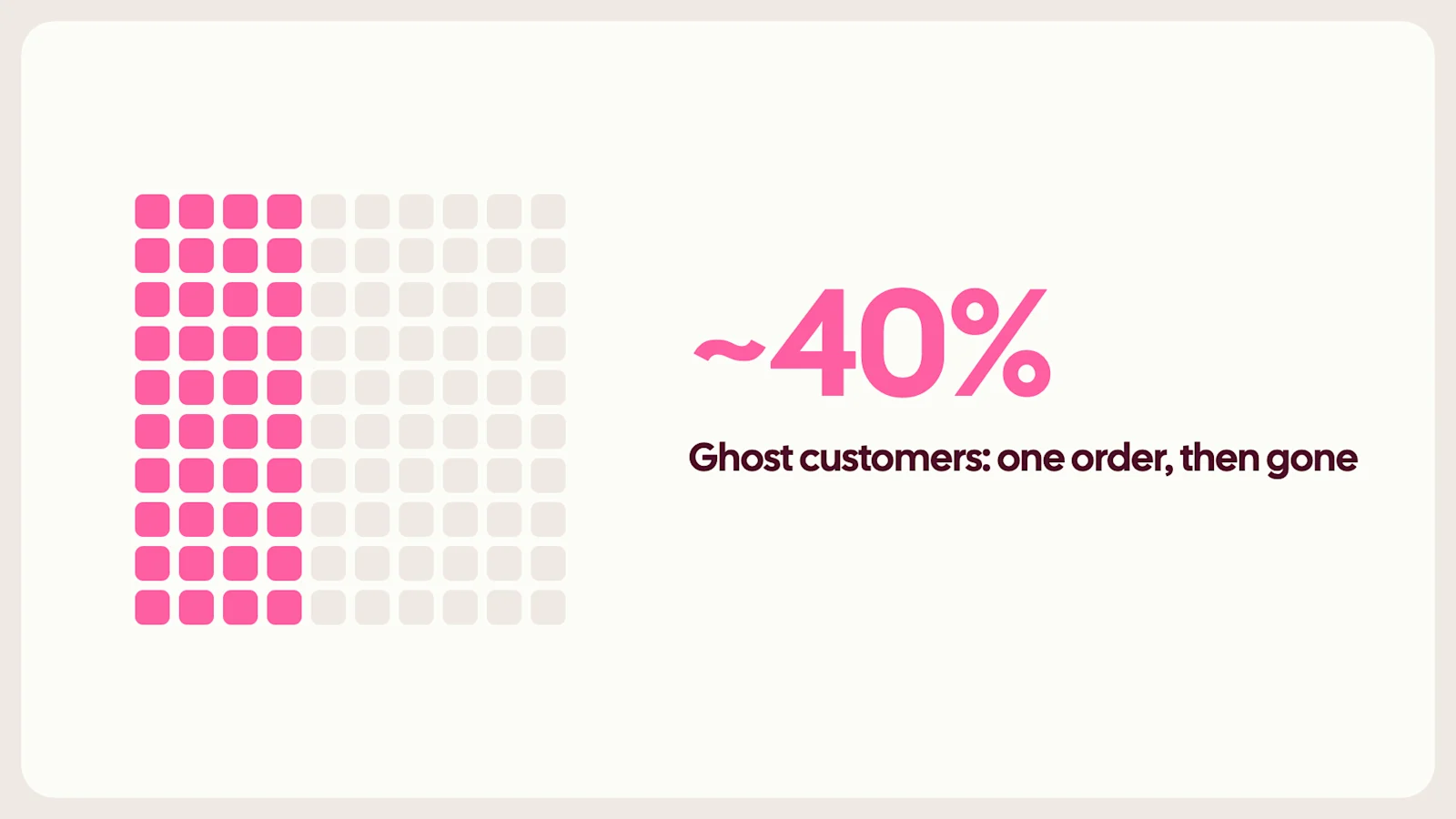
This insight pointed to a cause related to acquisition, not the product, with a greater number of ghost customers arriving through Google Shopping ads. They'd click to buy one specific thing, such as a pair of New Balance shoes or Levi's jeans, and not return to buy anything else.
So Rob ran with it. He had Claude create checkpoint files to save the Omni workbooks and custom SQL along the way, ensuring the findings could be carried on in fresh sessions.
He ended up building a 12-section report with 17 charts by spending a few hours on his phone, an analytical task that previously would have taken weeks of building and waiting.
The plan of action
With an understanding of the cause, the team can change how they engage one-time customers who haven't had an opportunity to browse more of their offerings yet. Now, they send follow-ups to highlight products that may have been missed and relevant new offers.
Next up, Rob is excited to weight acquisition with the prediction model so Google targets people most likely to return rather than just people who make the most money on the first order. "This allows us to be very deliberately action-orientated," he concludes.
The data team never received this request or validated the report during Rob's couch query — they didn't need to. The definitions Rob queried were the ones they already curated months earlier for everyone.
How every team goes further with AI #
Like Rob, stakeholders across the business are more confident exploring on their own.
One of Liubov's favorite examples is how merchandising colleagues can now decide what to bring in this year by analyzing specific brands, categories, or markets for flash sales.
Previously, they had to request help and work through a few rounds of clarification because pre-built dashboards don't provide the level of depth required to make these decisions. Now, they use Omni's agent on top of core dashboards to ask questions and provide clarifications live. The process was reduced from a few days to 15 minutes.
"For the end user, it's much quicker," Liubov says. "And for our team, we save time because we don't need to query the same thing for the 15th time. So it's a win-win."
More examples from across the business:
Trading team: Builds its own flash sale comparisons, replacing the need for ad hoc requests
Merchandising managers: Save 40 minutes a week by syncing data straight to Google Sheets instead of downloading individual CSVs
Brand managers: Build and send their own weekly replenishment numbers directly to secure new stock
Finance: Follows up on KPI fluctuations without a ticket
Lifecycle marketing: Slices campaigns by segment independently to reach every cohort with the right message
Supply and logistics: Plans demand against the single revenue definition to buy inventory that matches what the business actually expects to sell
The new shape of the data team #
"We don't have to spend a lot of time on the help-desk-y kind of stuff anymore," Wouter says. "We get to spend a lot more time on data engineering and data science projects: revenue forecasting, but also automated alerting, so you get ahead of the question. You start answering questions before they're actually there."
Giving everyone the ability to build has also introduced new work the team is learning to tackle related to QA.
While Omni's semantic layer ensures metrics and definitions are enforced, it's now more important to teach people how to "trust but verify" what they build since the data team is no longer involved in every query. The team also dedicates more time to cleaning up unused content (since everyone is building dashboards "like there's no tomorrow") and using Omni's AI Hub to continuously identify opportunities to tune the model.
"As data analysts, we are happy with the change," Liubov says. "The work is definitely more challenging, but it's more promising for the business. It's just more interesting."